
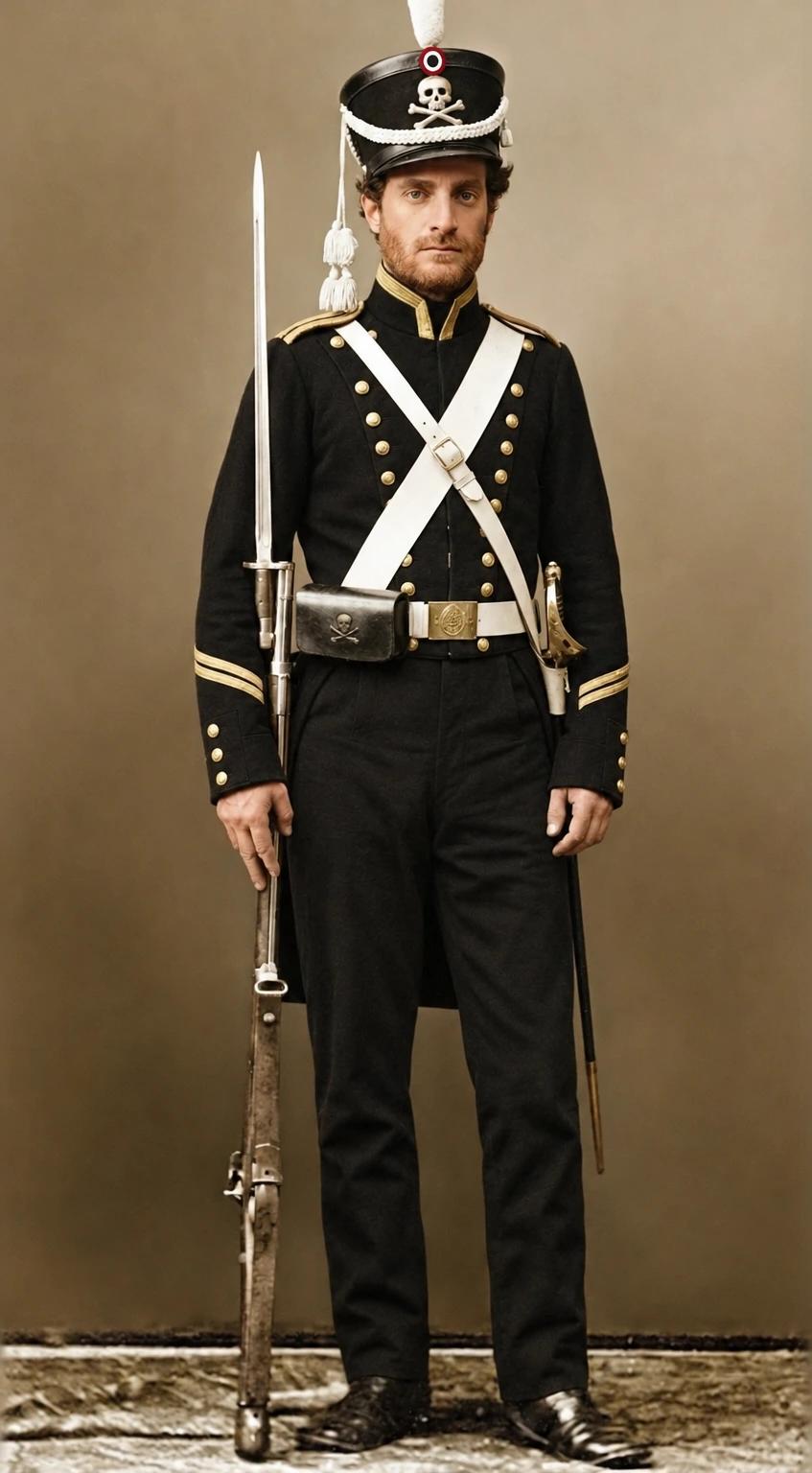
Uniform and equipment
| Uniform | Black uniform, death's head cap |
|---|---|
| Dress uniform | N/A |
| Headgear | Visored cap with skull |
| Equipment | Musket, bayonet |
| Insignia and standard | Skull and crossbones with motto 'Freedom or Death' |
Service record
| First appeared | 1821 |
|---|---|
| Peak strength | 500 men |
| Recruited from | Students / Diaspora |
| Primary tactic | Line Infantry |
| Signature engagement | Battle of Drăgășani (1821) |
| Motto or battle cry | Eleftheria i Thanatos (Freedom or Death) |
| Obsolescence | Wiped out in battle |
Timeline
- 1821: Crossing the Pruth. Alexandros Ypsilantis crosses the Pruth river into the Danubian Principalities, signaling the start of the revolt.
- 1821: Formation at Focșani. The unit is officially constituted from Greek student volunteers attending universities in Europe and Russia.
- 1821: The Oath of the Sacred Band. In a solemn ceremony, the volunteers swear 'Freedom or Death' before the icon of St. Constantine.
- 1821: Battle of Drăgășani. The unit is decimated by Ottoman forces; hundreds of students perish in a heroic last stand.
- 1821: Disbandment. Following the catastrophic defeat and the collapse of the revolt in the Principalities, the survivors scatter or flee to Austria.
Battles
Battle of Drăgășani
The unit's baptism of fire and graveyard. Abandoned by their cavalry support, the students formed squares against seasoned Ottoman Sipahis. Despite disciplined volley fire, they were overrun and massacred, sacrificing the 'flower of Greek youth' to ignite the revolutionary fire elsewhere.
Commanders
Alexandros Ypsilantis
A one-armed veteran of the Russian Imperial Army and leader of the Filiki Eteria. He envisioned the Sacred Band not merely as soldiers, but as the moral vanguard of Greek liberty, rallying the youth of the diaspora to die for a homeland many had never seen.
Nikolaos Ypsilantis
Brother to Alexandros, he commanded the Sacred Band on the muddy fields of Drăgășani. Refusing to retreat as the Ottoman cavalry broke their lines, he fought amidst the slaughter of his student-soldiers, surviving only by sheer chance to carry the burden of their memory.
Tactics
Napoleonic Line Drill
Unlike the irregular Klephts, the Sacred Band utilized rigid European linear formations to maximize firepower from smoothbore muskets.
Infantry Square
A defensive formation intended to repel cavalry charges by presenting a wall of bayonets in all directions, used desperately at Drăgășani.
Volley Fire
Massed, simultaneous discharge of muskets commanded by officers to break enemy morale and inflict concentrated damage.