
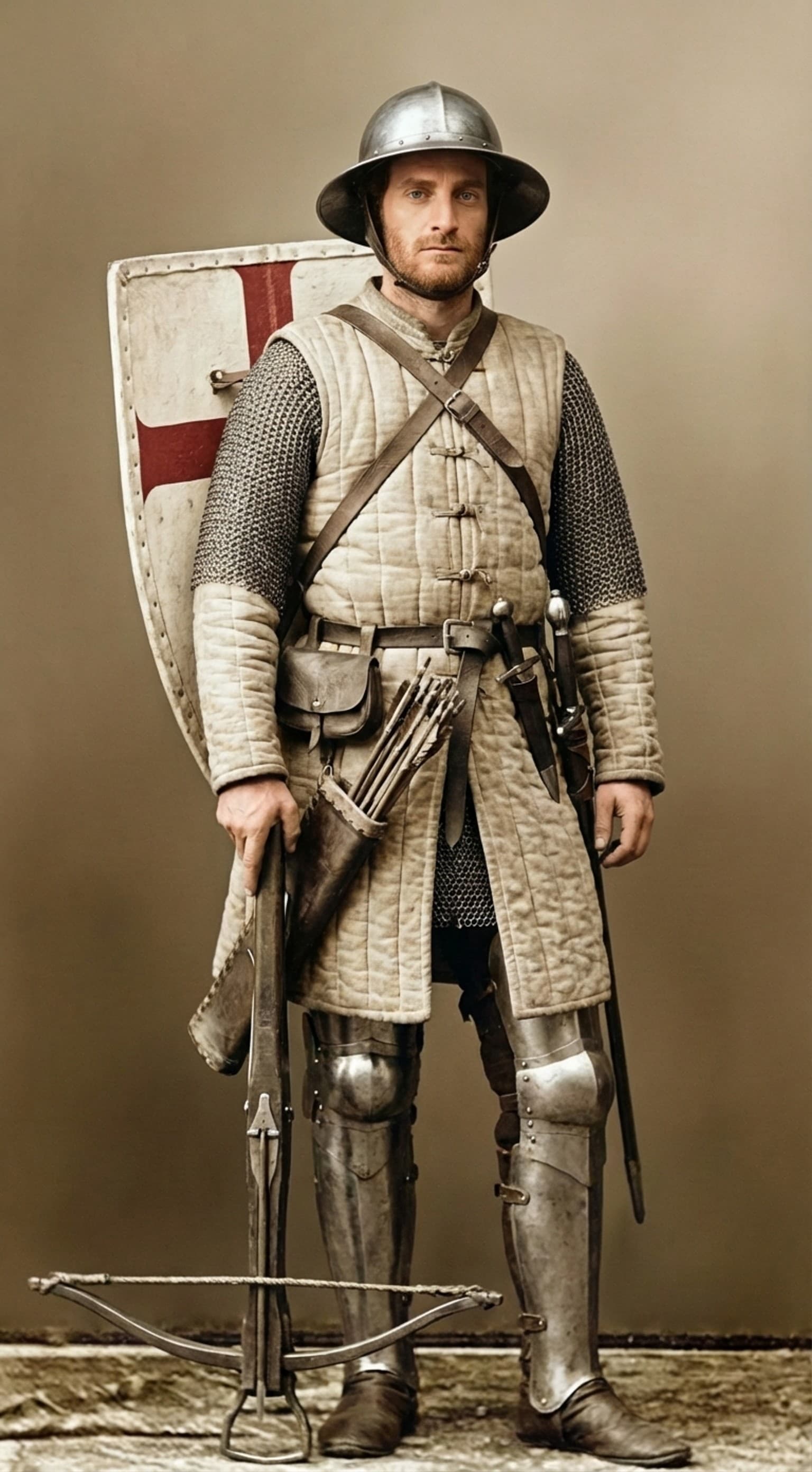
Uniform and equipment
| Uniform | Chainmail, brigandine, pavise shield on back |
|---|---|
| Dress uniform | Decorated pavises with heraldry |
| Headgear | Bascinet or kettle hat |
| Equipment | Heavy crossbow, pavise shield, sword |
| Insignia and standard | Cross of St. George on pavise |
Service record
| First appeared | 11th Century |
|---|---|
| Peak strength | 6,000 at Crecy |
| Recruited from | Urban Militia / Professionals |
| Primary tactic | Protected Volley Fire |
| Signature engagement | Battle of Crécy (1346) |
| Motto or battle cry | San Giorgio! (Saint George!) |
| Obsolescence | Handguns / Longbow Dominance |
Timeline
- 1099: First Crusade Participation. Genoese crossbowmen and engineers prove instrumental in the Siege of Jerusalem, establishing their reputation.
- 1192: Defense of Jaffa. Richard the Lionheart utilizes Genoese mercenaries to create an impenetrable wall of bolts against Saladin's cavalry.
- 1284: Battle of Meloria. The unit cements Genoa's dominance over Pisa in a decisive naval engagement.
- 1346: The Slaughter at Crécy. Tactical misuse by the French leads to a catastrophic loss of life and reputation against English longbows.
- 1380: War of Chioggia. Genoese forces are defeated by Venice, marking the beginning of the decline of Genoese military hegemony.
- 1525: Obsolescence. The widespread adoption of the arquebus renders the slow-loading crossbow mercenary guilds largely obsolete.
Battles
Siege of Jerusalem
Under Guglielmo Embriaco, Genoese engineers and crossbowmen dismantled their own ships to build siege towers. Their covering fire suppressed the Fatimid defenders on the walls, allowing the Crusaders to breach the Holy City.
Battle of Meloria
The definitive naval triumph over rival Pisa. Genoese crossbowmen rained death upon Pisan crews, clearing the decks for boarding parties. This victory established Genoese naval supremacy in the Western Mediterranean for a century.
Battle of Crécy
The unit's darkest hour. Forced to advance without their pavises and hampered by rain-slackened strings, they were outranged by English longbows. Retreating under fire, they were ruthlessly trampled by the French knights who had hired them, marking a tragic end to their elite reputation.
Commanders
Ottone Doria
A hardened mercenary captain who led the Genoese contingent at the disastrous Battle of Crécy. Despite his protests against attacking without their defensive pavises, he led his men into the mud against the English longbows, fighting bravely until he was cut down in the ensuing chaos.
Rainier Grimaldi
A scion of Genoa's most powerful family and Admiral of France. Grimaldi mastered the integration of heavy crossbowmen into naval warfare, using their armor-piercing volleys to sweep enemy decks before boarding actions, most notably securing French dominance at the Battle of Zierikzee.
Tactics
The Pavise Wall
Crossbowmen would plant their large shields in a line, creating a temporary fortification that allowed them to reload in safety while maintaining a continuous front.
Rolling Volley
Divided into three ranks: one firing, one reloading, and one preparing. This rotation maintained a constant stream of bolts to suppress enemy movement.
Naval Deck Sweeping
Positioned in the fighting tops and forecastles of galleys, they utilized the flat trajectory of crossbows to snipe enemy officers and helmsmen before boarding.