
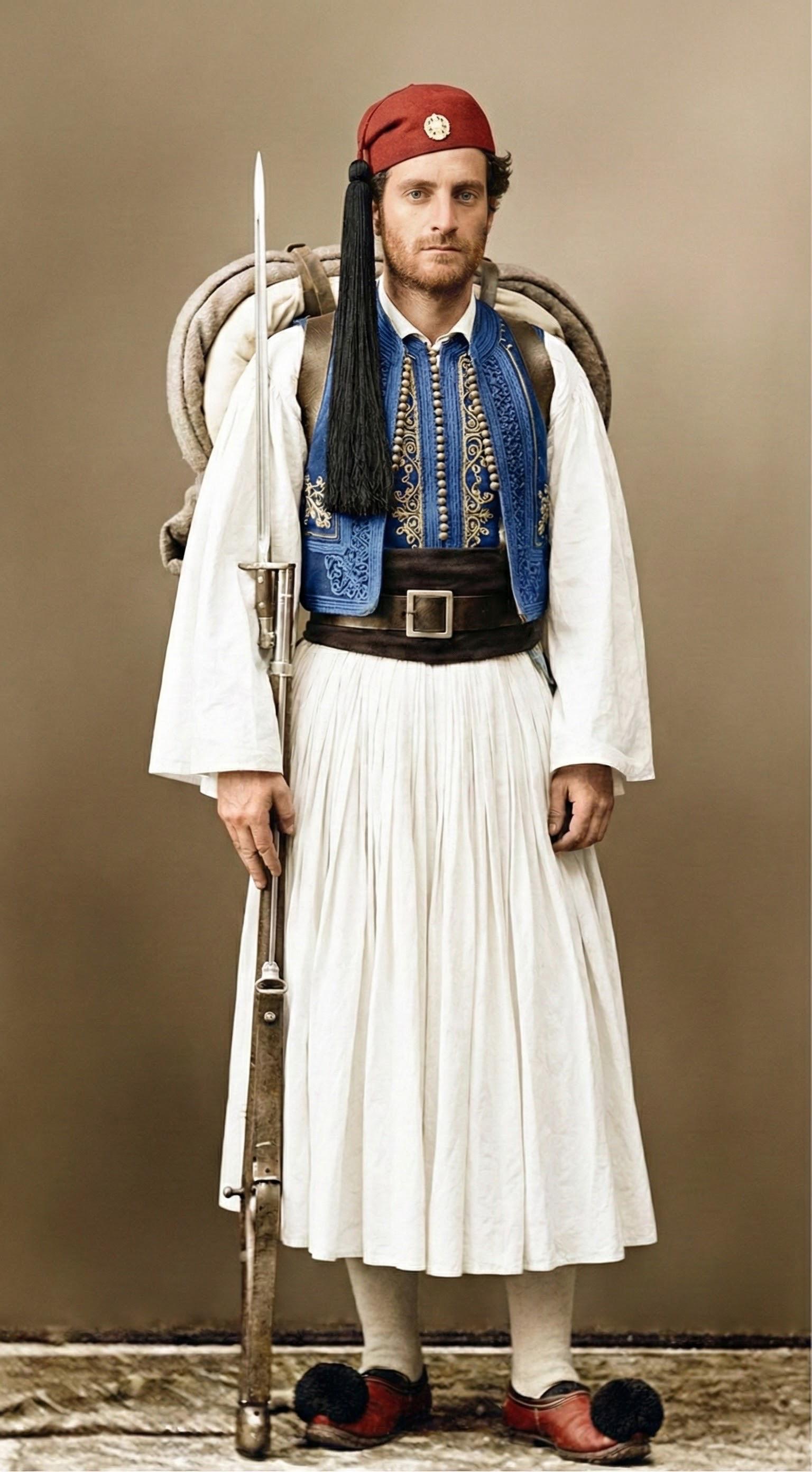
Uniform and equipment
| Uniform | White fustanella (kilt), embroidered jacket, white hose |
|---|---|
| Dress uniform | Elaborate gold-embroidered jacket and skirt |
| Headgear | Red fez with long black tassel |
| Equipment | Rifle, traditional sword |
| Insignia and standard | Greek coat of arms (blue shield, silver cross) surmounted by royal crown |
Service record
| First appeared | 1833 |
|---|---|
| Peak strength | 3,000 men |
| Recruited from | Mountain Klephts / Volunteers |
| Primary tactic | Mountain Warfare |
| Signature engagement | Balkan Wars (1912-1913) |
| Motto or battle cry | Aera! (Wind/Air - battle cry) |
| Obsolescence | Role changed to Ceremonial |
Timeline
- 1867: Formation. Four light infantry battalions are officially constituted to guard the borders, drawing lineage from the Klephts and Armatoles of the War of Independence.
- 1897: Greco-Turkish War. Evzones see their first major conventional combat, distinguishing themselves despite the overall Greek defeat.
- 1912: Balkan Wars. The golden era of the Evzones. They spearhead the liberation of Macedonia and Epirus, earning a reputation for suicidal bravery.
- 1919: Asia Minor Campaign. Evzone regiments land in Smyrna and push deep into Anatolia, serving as the elite shock troops of the Greek Army.
- 1940: The Albanian Epic. Evzones repel the Italian invasion in the Pindus mountains, shouting their war cry 'Aera!' (Wind) as they counter-attacked.
- 1944: Resistance and Liberation. While the official army was disbanded, resistance groups like the 5/42 Regiment maintained the Evzone identity fighting the Wehrmacht.
- 1974: Ceremonial Transition. Following the fall of the Junta and army reorganization, the Evzones transition fully to the Presidential Guard, serving as ceremonial sentinels.
Battles
Battle of Kilkis-Lachanas
A brutal frontal assault during the Second Balkan War. Evzone units charged fortified Bulgarian positions with bayonets fixed, suffering horrific casualties but breaking the enemy line through sheer aggression and morale.
Battle of Bizani
The decisive engagement for the liberation of Ioannina. Evzones executed a daring flanking maneuver through frozen mountain terrain deemed impassable, surprising the Ottoman garrison and forcing a surrender.
Battle of Hill 731
The 'Verdun of the Balkans.' Evzones held the line against a massive Italian Spring Offensive. Under heavy artillery fire that reshaped the landscape, they repelled 18 assaults, shattering Mussolini's ambitions in the mountains.
Commanders
Nikolaos Plastiras
Known as 'The Black Rider,' Plastiras commanded the legendary 5/42 Evzone Regiment. His unit was so feared by the enemy during the Greco-Turkish War that they were dubbed 'The Devil's Army.' He led from the front, embodying the ferocious spirit of the mountain warriors.
Dimitrios Psarros
A patriot of unwavering principle, Psarros founded the 5/42 Evzone Regiment of the EKKA resistance group during WWII. He sought to maintain the Evzone tradition of mountain warfare against Axis occupation, ultimately sacrificing his life amidst the chaos of the Greek Civil War.
Konstantinos Koukidis
A figure of national legend. As the Nazis occupied the Acropolis in 1941, this Evzone guard allegedly refused to surrender the Greek flag, wrapping himself in it and leaping to his death. He symbolizes the Evzone refusal to submit to tyranny.
Tactics
The 'Aera' Charge
A psychological and physical shock tactic. Evzones would shout 'Aera!' (Wind) to signify sweeping the enemy away, followed by a relentless bayonet charge regardless of incoming fire.
Mountain Envelopment
Leveraging their upbringing in rugged terrain, Evzones specialized in scaling 'impassable' cliffs to flank entrenched enemy positions, bypassing heavily defended roads.
Aggressive Patrolling
Operating as elite light infantry, they conducted deep reconnaissance and night raids to harass enemy supply lines and sow confusion before main assaults.