
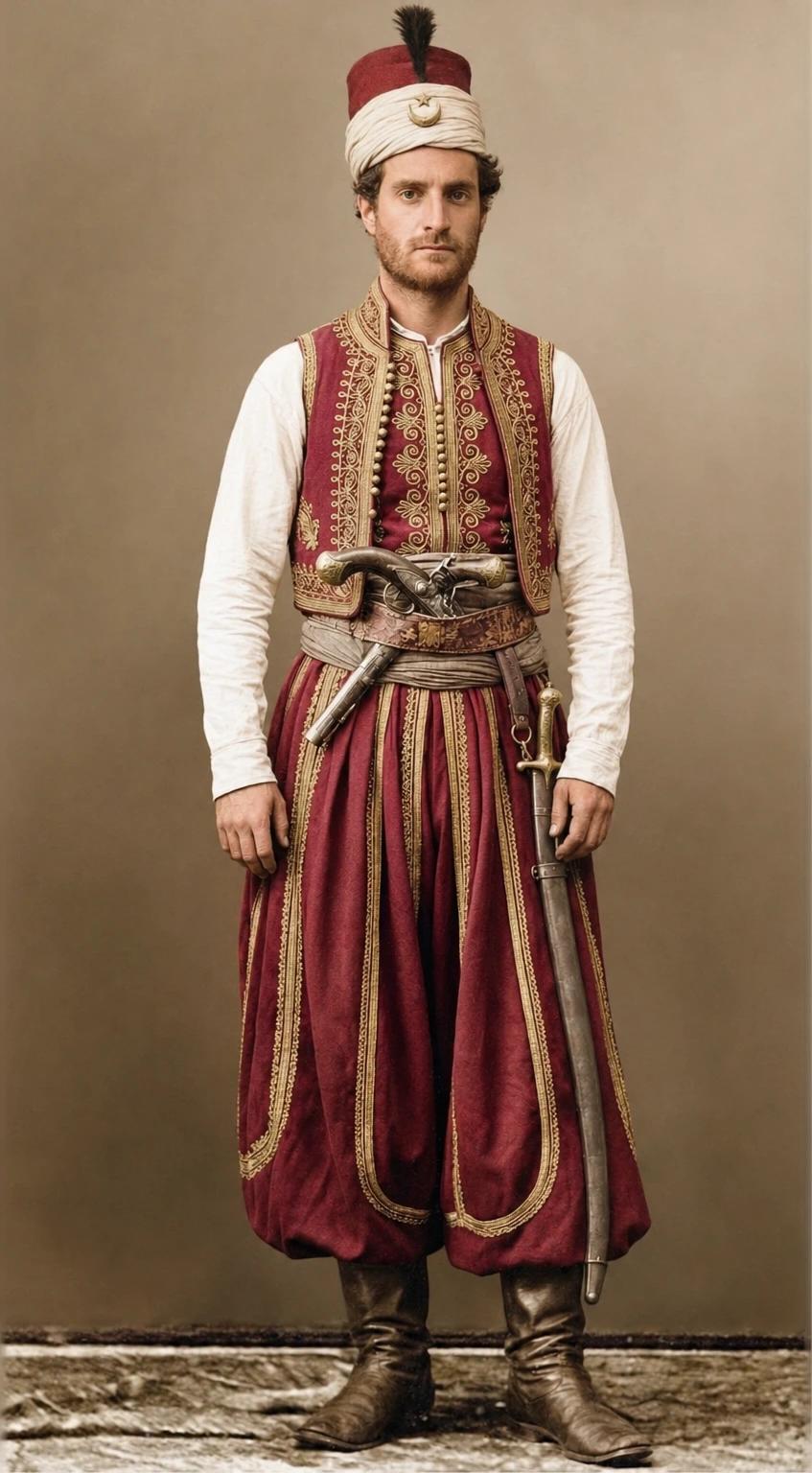
Uniform and equipment
| Uniform | Oriental dress: silk shirt, baggy trousers, turban vest |
|---|---|
| Dress uniform | Silk robes, jeweled scimitars, gold embroidery |
| Headgear | Turban with aigrette or jeweled cap |
| Equipment | Curved scimitar, pistols, dagger |
| Insignia and standard | Circular brass shako plate with crescent (Miroir) |
Service record
| First appeared | 1798 |
|---|---|
| Peak strength | 500 men |
| Recruited from | Slave Soldiers / Egyptian Auxiliaries |
| Primary tactic | Individual Combat Skill / Shock |
| Signature engagement | Battle of Austerlitz (1805) |
| Motto or battle cry | Allah! Allah! (God! God!) |
| Obsolescence | Abdication of Napoleon |
Timeline
- 1799: Formation in Egypt. General Kléber organizes a company of Mameluke auxiliaries from defectors and purchased slaves to serve the French Army of the Orient.
- 1801: Exile to France. Following the French evacuation of Egypt, the Mamelukes accompany the army to Marseille, forming the nucleus of a new squadron.
- 1804: Imperial Guard Integration. Napoleon officially attaches the Mamelukes to the Chasseurs à Cheval of the Imperial Guard, granting them elite status.
- 1805: Charge at Austerlitz. The squadron achieves legendary status by breaking the Russian Imperial Guard cavalry, earning Napoleon's eternal favor.
- 1814: Royalist Purge. After Napoleon's first abdication, Royalist mobs in Marseille massacre many Mameluke families; the unit is dispersed.
- 1815: The Hundred Days. A small remnant rallies to Napoleon for the Waterloo campaign, marking the final, tragic end of the corps.
Battles
Battle of Austerlitz
The Mamelukes' defining hour. In a desperate melee against the Russian Chevalier Guards, they utilized their curved sabers to devastating effect. They captured standards and prisoners, turning the tide on the Pratzen Heights and cementing their reputation as the Emperor's elite shock troops.
Battle of Eylau
Amidst a blinding blizzard, the Mamelukes charged into the Russian lines. Despite the freezing conditions rendering firearms useless, their mastery of the blade allowed them to cut a bloody path through the snow, though the unit suffered significant casualties in the chaotic slaughter.
Dos de Mayo Uprising
A brutal urban skirmish where the Mamelukes suppressed a Spanish civilian uprising. Their exotic appearance and ruthless efficiency in the narrow streets fueled anti-French propaganda, painting them as 'heathen butchers' and igniting a savage guerrilla war across the peninsula.
Commanders
Jean Rapp
A fearless Alsatian general who frequently led the Mamelukes into the thickest fighting. At Austerlitz, with a broken saber and covered in blood, he led the Mameluke squadron in a legendary counter-charge that shattered the Russian Imperial Guard cavalry.
Roustam Raza
Born in Georgia and enslaved in Egypt, Roustam became Napoleon's shadow. Fiercely loyal, he slept across the Emperor's door, serving as bodyguard and valet. While not a field commander, he was the living icon of the Mameluke corps, representing their exotic allure and fanatical devotion.
Tactics
The Swarm Charge
Unlike the rigid lines of European heavy cavalry, Mamelukes attacked in a loose 'swarm,' allowing individual riders to exploit gaps in enemy formations and engage in single combat.
Draw-Cut Decapitation
Leveraging the extreme curve of the Shamshir, they aimed high at the neck or shoulders. The blade's geometry allowed it to slice through flesh and bone without getting stuck, unlike straight sabers.
Rolling Fire
Carrying a carbine, blunderbuss, and two to four pistols, a single Mameluke could unleash a withering barrage of fire immediately before the collision of steel.