
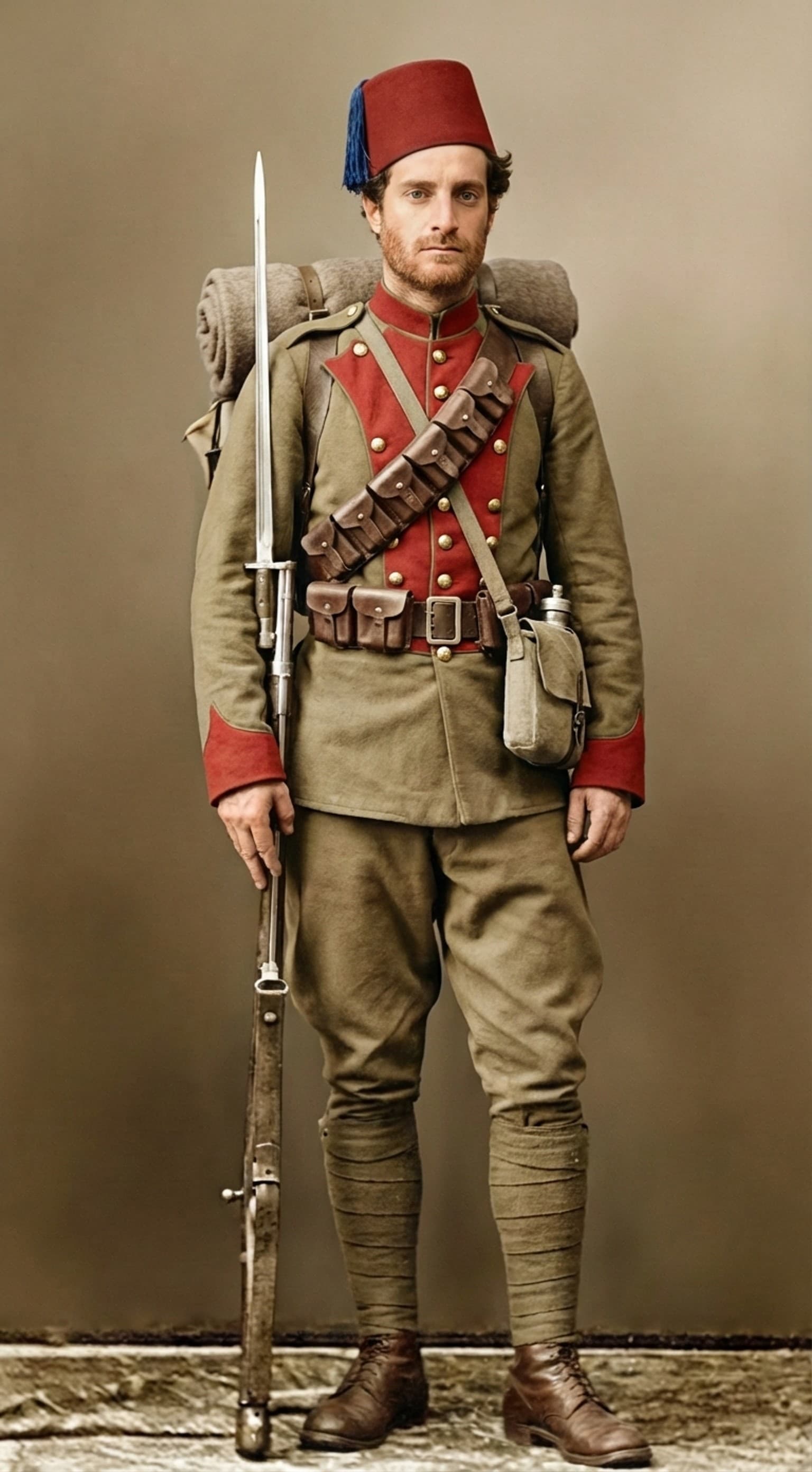
Uniform and equipment
| Uniform | Khaki tunic, shorts or breeches, puttees; officers with Sam Browne belts |
|---|---|
| Dress uniform | Khaki service dress with polished leather, sometimes colored sashes |
| Headgear | Wolseley helmet or tarboosh with sun cover |
| Equipment | Rifle, bayonet, camel equipment |
| Insignia and standard | Star and Crescent brass badge |
Service record
| First appeared | 1880s |
|---|---|
| Peak strength | ~2,000 troopers |
| Recruited from | Egyptian/Sudanese Soldiers |
| Primary tactic | Desert Mobility / Dismounted Fire |
| Signature engagement | Battle of Omdurman (1898) |
| Motto or battle cry | Nomina Desertis Inscripsimus (In the Desert We Have Written Our Names) |
| Obsolescence | Motorization |
Timeline
- 1883: Reorganization. Following the disaster at El Obeid, the Egyptian Army is disbanded and reformed under British officers, establishing the Camel Corps.
- 1884: Gordon Relief Expedition. Early iterations of the corps participate in the failed attempt to save General Gordon at Khartoum.
- 1896: Dongola Expedition. The Corps spearheads the advance south, proving vital in securing the logistics chain across the desert.
- 1898: Fall of Omdurman. The Corps plays a pivotal tactical role in the destruction of the Mahdist state's main army.
- 1899: Battle of Umm Diwaykarat. The final defeat of the Khalifa, marking the end of major combat operations in the Sudan.
Battles
Battle of Firket
A surprise dawn attack where the Camel Corps utilized their mobility to flank the Mahdist positions. The engagement proved the reformed Egyptian Army's discipline, shattering the myth of Dervish invincibility in the first major action of the reconquest.
Battle of Omdurman
The decisive clash. While maxims mowed down the frontal charge, the Camel Corps fought a desperate, gritty holding action on the rocky heights of Jebel Surgham, preventing the Mahdist right wing from flanking Kitchener's main force.
Battle of Atbara
A brutal assault on a fortified Mahdist zareba. The Camel Corps screened the advance and protected the flanks, enduring withering fire before the Anglo-Egyptian force stormed the defenses with bayonets drawn.
Commanders
Horatio Herbert Kitchener
The Sirdar of the Egyptian Army. A figure of icy calculation and ruthless efficiency, Kitchener rebuilt the Egyptian forces from the ground up, forging the Camel Corps into a logistical and tactical weapon capable of conquering the unforgiving Nubian Desert.
Major R.J. Tudway
A British officer of the Essex Regiment attached to the Egyptian Army. As the field commander of the Camel Corps during the Dongola Expedition, he led his mounted infantry with grit across scorching sands, earning a reputation for relentless pursuit.
Tactics
Dismounted Volley Fire
Camels were transport, not tanks. Upon contact, troops would force camels to kneel (barracking), hobble them, and form a firing line on foot to deliver disciplined volleys.
The Desert Square
When threatened by cavalry or massed infantry, the unit formed a defensive square, often using hobbled camels as a living breastwork to break the momentum of the enemy charge.
Long-Range Reconnaissance
Operating days ahead of the main column, they located wells and enemy concentrations in terrain that would kill horses, acting as the army's eyes.