
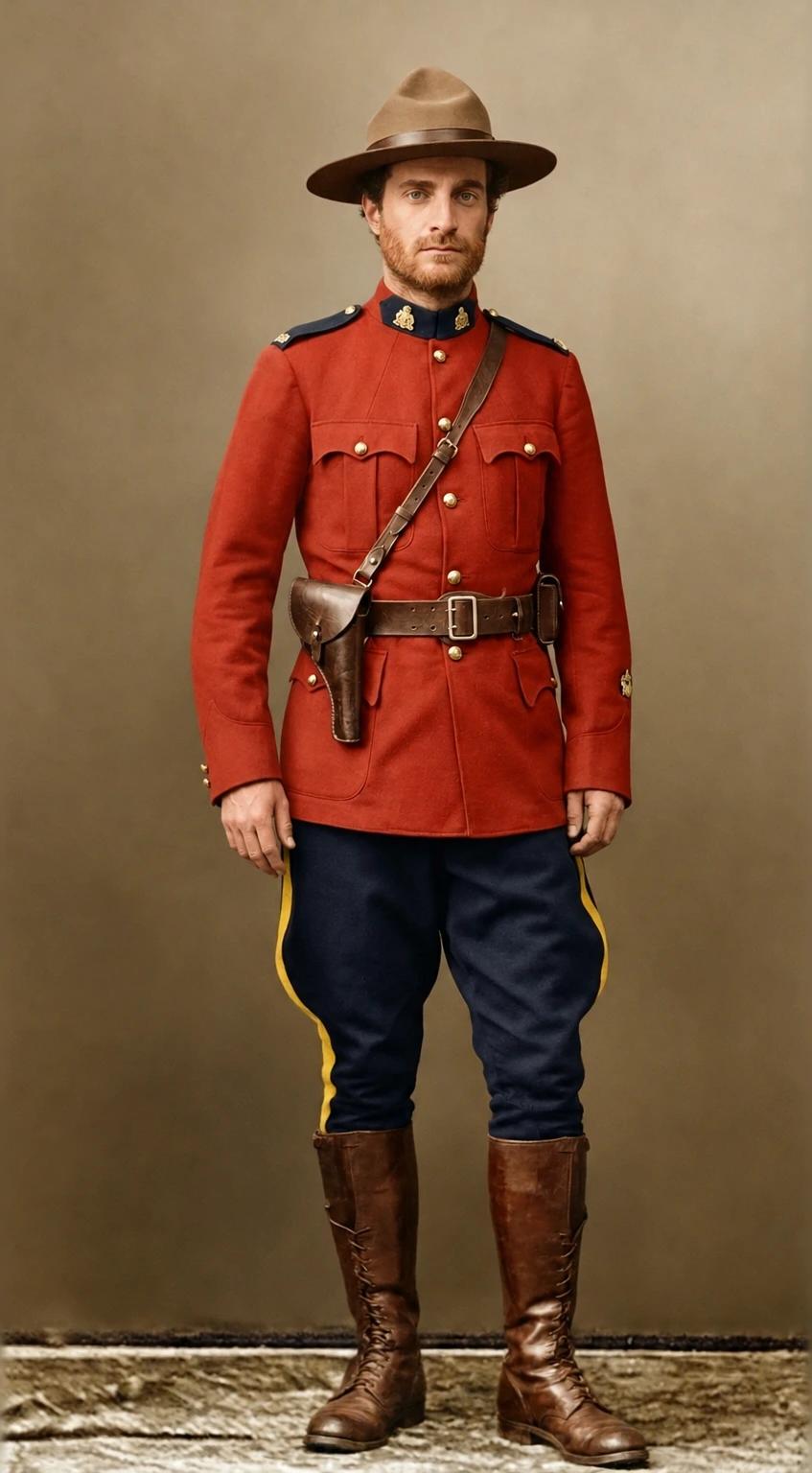
Uniform and equipment
| Uniform | Red serge tunic, breeches, boots |
|---|---|
| Dress uniform | Red serge, Sam Browne belt |
| Headgear | Stetson hat (Campaign hat) |
| Equipment | Revolver, carbine |
| Insignia and standard | Bison head badge with Maintiens le Droit |
Service record
| First appeared | 1873 |
|---|---|
| Peak strength | Thousands |
| Recruited from | Volunteers |
| Primary tactic | Policing / Mounted Infantry |
| Signature engagement | North-West Rebellion (1885) |
| Motto or battle cry | Maintiens le Droit (Defend the Right) |
| Obsolescence | N/A (Still Active) |
Timeline
- 1873: Formation. Parliament passes the act establishing the North-West Mounted Police to bring law to the chaotic frontier.
- 1874: The March West. A grueling trek of over 275 men across the prairies to assert Canadian sovereignty and suppress the whiskey trade.
- 1877: Sitting Bull's Arrival. Sioux warriors cross into Canada after Little Bighorn; the NWMP manages the tense diplomatic crisis.
- 1885: North-West Rebellion. The Force transitions from policing to paramilitary combat operations against Métis and First Nations insurgents.
- 1898: Klondike Gold Rush. Sam Steele and the NWMP secure the Yukon passes, enforcing strict entry requirements and maintaining order.
- 1904: Royal Title. King Edward VII confers the title 'Royal', renaming the unit the Royal North-West Mounted Police (RNWMP).
- 1920: Amalgamation. The RNWMP merges with the Dominion Police to form the modern Royal Canadian Mounted Police (RCMP).
Battles
Battle of Batoche
The decisive climax of the North-West Rebellion. Alongside militia units, the NWMP stormed the Métis rifle pits. It was a gritty, desperate charge that broke Louis Riel's provisional government and ended the uprising.
Battle of Cut Knife
An NWMP and militia column attempted a surprise attack on a Cree and Assiniboine camp. Outmaneuvered by Chief Poundmaker's warriors in rough terrain, the police were forced into a fighting retreat, narrowly escaping annihilation.
The Almighty Voice Manhunt
A tragic, protracted siege ending a 19-month manhunt for a Cree fugitive. The NWMP utilized field guns to shell a poplar bluff, killing the holdouts. It marked the grim end of the frontier era and the transition to modern law enforcement.
Commanders
Sir Sam Steele
A titan of the frontier, Steele personified the Force's grit. From the Great March West to policing the chaotic Klondike Gold Rush, his imposing physical presence and unyielding adherence to the law brought order to the wildest corners of the Dominion.
James Macleod
A lawyer and soldier who understood that peace was forged through trust, not just gunpowder. By building a respectful rapport with Chief Crowfoot and the Blackfoot Confederacy, he prevented bloodshed on the plains and established the Force's reputation for fairness.
Tactics
Mounted Infantry Skirmish
Unlike cavalry charges, the NWMP fought on foot. One man held four horses while three deployed into a firing line.
Two-Man Patrol
Small teams traversed vast distances in harsh weather, relying on self-sufficiency to monitor indigenous tribes and settlers.
Diplomatic Pow-Wow
Officers often rode unarmed into armed camps to negotiate, using courage and oratory skills to diffuse volatile situations.