
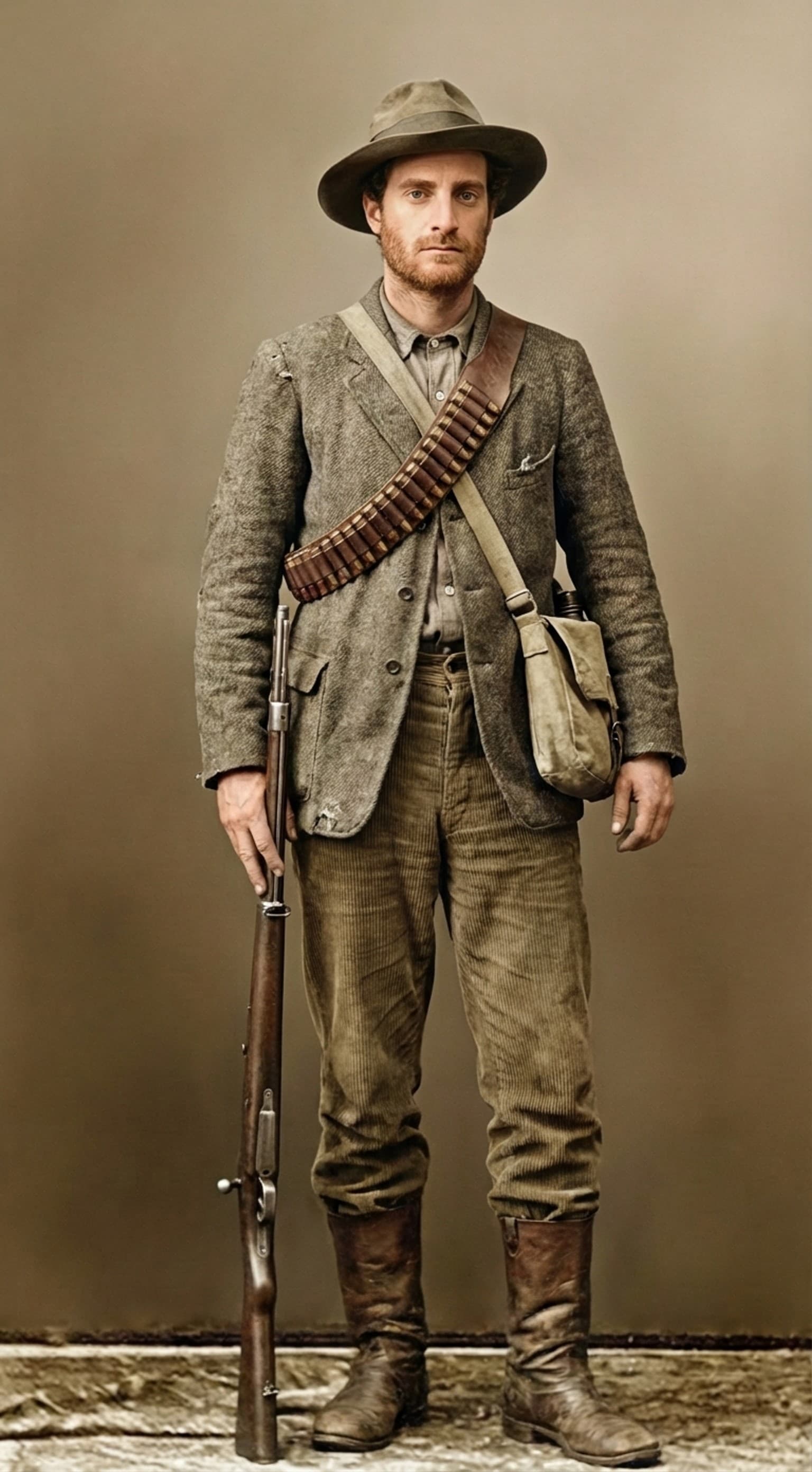
Uniform and equipment
| Uniform | Civilian clothes, bandoliers, slouch hat |
|---|---|
| Dress uniform | N/A |
| Headgear | Slouch hat |
| Equipment | Mauser rifle, horse |
| Insignia and standard | None (citizen militia) |
Service record
| First appeared | 19th Century |
|---|---|
| Peak strength | 40,000 men |
| Recruited from | Citizen Militia (Burghers) |
| Primary tactic | Mobile Sniping / Ambush |
| Signature engagement | Battle of Spion Kop (1900) |
| Motto or battle cry | Eendragt Maakt Magt (Unity Makes Strength) |
| Obsolescence | British Annexation |
Timeline
- 1715: Commando System Established. The Dutch East India Company establishes the first mounted civilian militias for frontier defense.
- 1881: First Boer War Victory. Commandos defeat the British Empire, confirming the effectiveness of mobile marksmanship.
- 1899: Outbreak of Second Boer War. Commandos mobilize to invade Natal and the Cape Colony before British reinforcements arrive.
- 1899: Black Week. A trio of stunning Boer victories (Stormberg, Magersfontein, Colenso) shocks the British Empire.
- 1900: Fall of Pretoria. British forces capture the capitals; the Commando leadership decides to switch to guerrilla warfare.
- 1902: Treaty of Vereeniging. The bitter end. Commandos lay down their arms as the Republics are absorbed into the British Empire.
Battles
Battle of Majuba Hill
The decisive engagement of the First Boer War. Using fire-and-movement tactics, Boers stormed a British-held summit, inflicting heavy casualties and securing the independence of the Transvaal Republic.
Battle of Magersfontein
De la Rey's tactical masterpiece. Instead of holding the high ground, Boers hid in concealed trenches at the hill's base. They decimated the advancing Highland Brigade at point-blank range in the pre-dawn darkness.
Battle of Spion Kop
A brutal, close-quarters carnage atop a fog-shrouded hill. Boer marksmen pinned down British forces on the exposed summit, raining Mauser fire until the British withdrew in a chaotic, bloody defeat.
Battle of Paardeberg
General Cronjé, encumbered by wagon trains and families, was surrounded by British forces. After days of relentless bombardment in the riverbed, 4,000 Boers surrendered, marking a turning point in the conventional war.
Commanders
Louis Botha
A natural strategist and statesman, Botha commanded the Boer forces to stunning victories during 'Black Week.' His leadership at Spion Kop demonstrated his ability to hold the line against overwhelming imperial numbers.
Christiaan de Wet
The elusive 'Fox of the Veld,' de Wet was a master of guerrilla warfare. A rugged disciplinarian, he led his burghers on exhausting rides to strike British supply lines, famously evading capture for years despite massive dragnets.
Koos de la Rey
Known as the 'Lion of the West,' de la Rey was a pacifist who fought with terrifying effectiveness. He revolutionized warfare by introducing trench tactics at Magersfontein and remained a chivalrous but deadly adversary until the bitter end.
Tactics
Mobile Marksmanship
Leveraging their hunting skills, Boers engaged targets at long range with deadly accuracy, then retreated on horseback before the enemy could close the distance.
Kopje Defense
Utilizing the rocky outcrops (kopjes) of the veld as natural fortresses, firing from behind boulders and using smokeless powder to remain invisible.
Trench Ambush
Innovated by De la Rey, this involved digging concealed trenches at the foot of hills rather than the crest, trapping attackers in flat, open killing zones.
Commando Swarm
Lacking formal drill, units would instinctively swarm toward the sound of gunfire, flanking enemy positions loosely but effectively.