
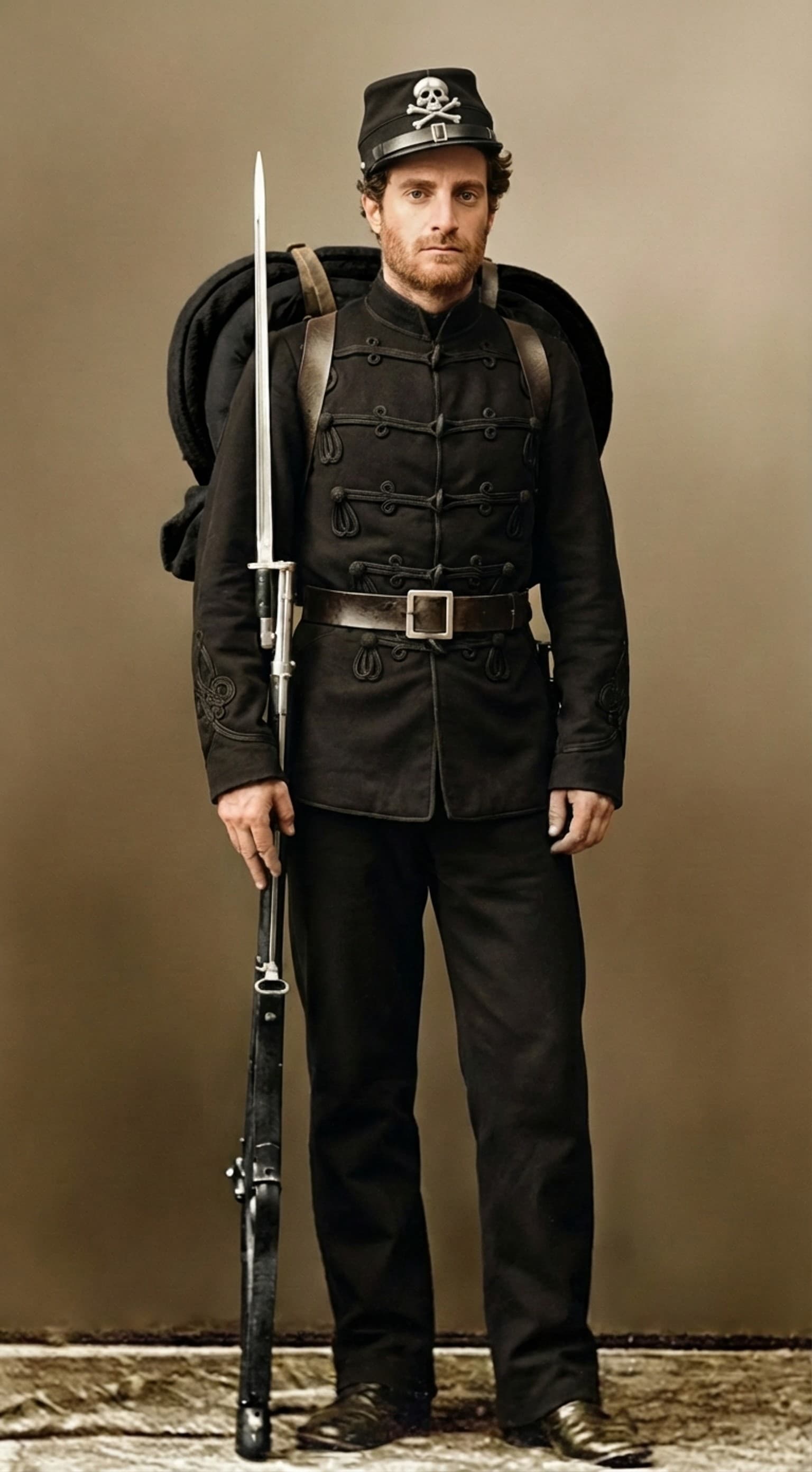
Uniform and equipment
| Uniform | Black tunic and trousers, silver skull-and-crossbones badges |
|---|---|
| Dress uniform | All-black dress with polished buttons, skull badges on shako |
| Headgear | Black shako with skull-and-crossbones front plate |
| Equipment | Musket, bayonet, sabre for cavalry elements |
| Insignia and standard | Silver Totenkopf on shako and cartridge box |
Service record
| First appeared | 1809 |
|---|---|
| Peak strength | ~2,300 men |
| Recruited from | Vengeful Volunteers |
| Primary tactic | Infantry Line / Shock |
| Signature engagement | Battle of Quatre Bras (1815) |
| Motto or battle cry | Victory or Death |
| Obsolescence | Integration into Prussian Army |
Timeline
- 1809: Formation in Bohemia. Frederick William raises a volunteer corps in Austrian territory to fight Napoleon.
- 1809: The Great Escape. After the defeat of Austria, the corps fights its way across Germany to the North Sea and is evacuated by the Royal Navy.
- 1810: Peninsular Service. The corps enters British service; the Oels Jäger regiment is deployed to fight in Spain and Portugal.
- 1813: Return to Brunswick. Following Napoleon's retreat from Russia, the Duke returns to liberate his homeland and recruits fresh troops.
- 1815: Death of the Duke. Frederick William is killed at Quatre Bras; the unit continues to fight under Olfermann at Waterloo.
- 1820: Integration. The distinct volunteer corps is eventually absorbed into the regular Brunswick Army.
Battles
Battle of Ölper
A desperate breakout engagement. The newly formed Black Horde, isolated in French-occupied Germany, seized a momentary victory against Westphalian forces, allowing them to retreat to the North Sea coast and escape to England.
Battle of Quatre Bras
The corps' defining tragedy. While holding the crossroads against Marshal Ney's onslaught, the Brunswickers suffered heavy casualties. The Black Duke was shot through the chest and died, galvanizing his men's resolve for the coming days.
Battle of Waterloo
Placed in the center-right of Wellington's line, the Brunswick squares withstood repeated fury from French cavalry. Despite their leader's recent death, their discipline held firm, preventing a French breakthrough near Hougoumont.
Commanders
Elias Olfermann
A capable officer who assumed command of the Black Corps amidst the chaos of Quatre Bras following the Duke's death. He successfully rallied the demoralized troops and led them with distinction through the carnage of Waterloo two days later.
Frederick William, Duke of Brunswick-Wolfenbüttel
Known as 'The Black Duke,' he embodied the corps' spirit of vengeance. Having lost his father and lands to Napoleon, he swore never to sheath his sword until France was defeated. He led with reckless bravery and was killed in action at Quatre Bras.
Tactics
Infantry Square
A defensive formation used extensively at Quatre Bras and Waterloo to repel French cavalry charges. The Brunswickers stood shoulder-to-shoulder, bayonets fixed, creating an impenetrable wall of steel.
Avant-Garde Skirmishing
The corps utilized specialized Jäger companies armed with rifles to screen the main force, harass the enemy, and cover tactical retreats.