
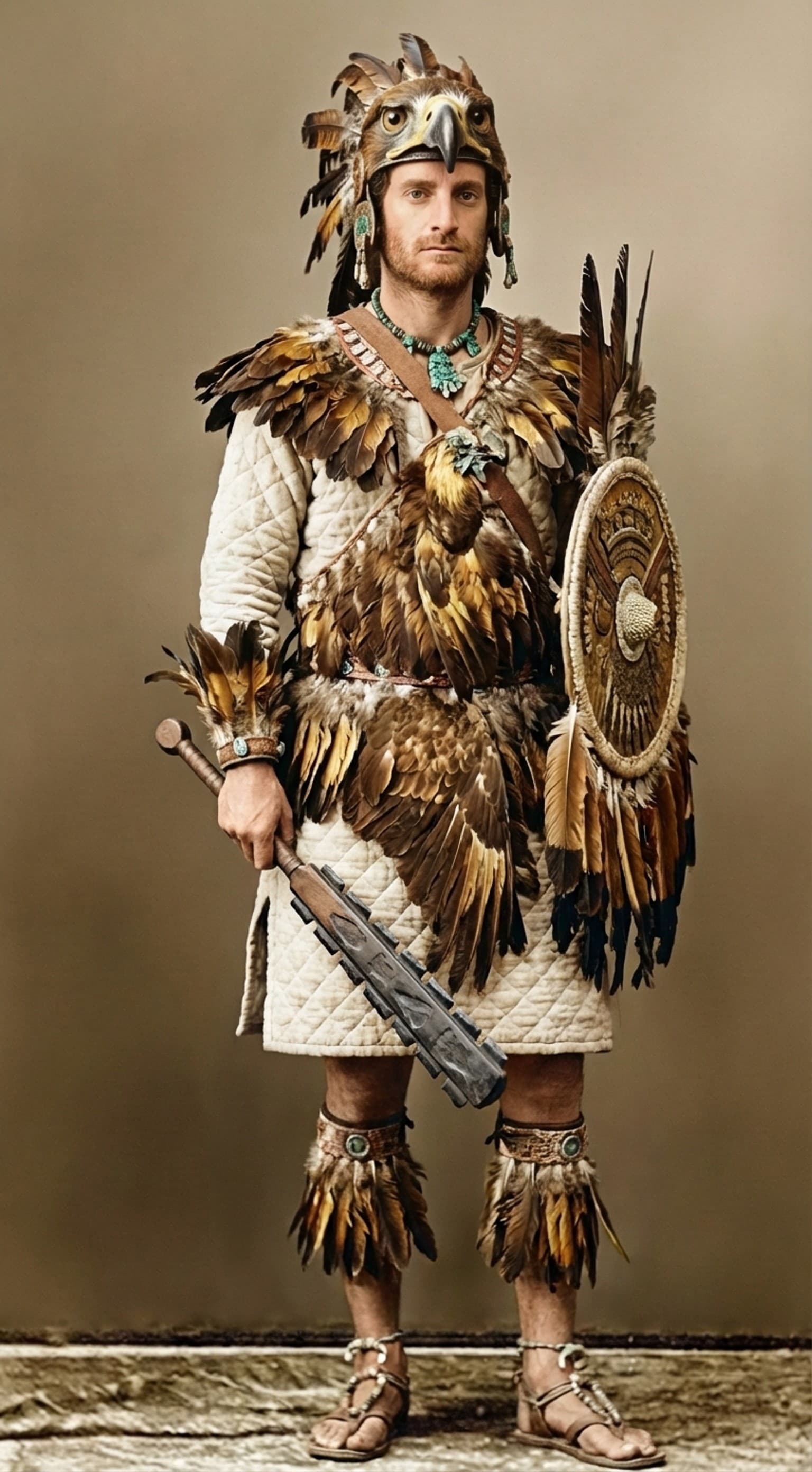
Uniform and equipment
| Uniform | Feathered body suit resembling eagle |
|---|---|
| Dress uniform | Elaborate eagle beak helmet, wings on back |
| Headgear | Eagle head helmet with open beak |
| Equipment | Macuahuitl, spear, shield |
| Insignia and standard | Eagle-head helmet (wood/papier-mâché) |
Service record
| First appeared | 14th Century |
|---|---|
| Peak strength | Elite cadres |
| Recruited from | Nobility / Proven Warriors |
| Primary tactic | Shock / Capture |
| Signature engagement | Fall of Tenochtitlan (1521) |
| Motto or battle cry | Mexico! Mexico! |
| Obsolescence | Spanish Conquest |
Timeline
- 1428: Formation of the Triple Alliance. The consolidation of power between Tenochtitlan, Texcoco, and Tlacopan creates the structural need for a standing elite military class.
- 1440: Reign of Moctezuma I. Institutionalization of the Eagle and Jaguar warrior societies; meritocratic promotion becomes law.
- 1487: Consecration of the Great Temple. Eagle Warriors secure thousands of captives from campaigns in Oaxaca for the massive dedication ceremonies.
- 1519: Arrival of Cortés. Spanish forces land; Eagle Warriors are initially held back due to diplomatic confusion before hostilities erupt.
- 1520: The Night of Sorrows. Eagle Warriors lead the expulsion of Spanish forces from the capital, inflicting massive casualties.
- 1521: Fall of the Empire. With the capture of Cuauhtémoc, the order is effectively dissolved, its members killed or forced into hiding.
Battles
Battle of Otumba
Despite overwhelming numbers, the Aztec lines broke when the Spanish cavalry charged the command structure. It demonstrated the Eagle Warriors' vulnerability to heavy cavalry charges in open fields, a tactical shock they could not adapt to in time.
La Noche Triste
Under the cover of rain, Eagle Warriors ambushed the retreating Spanish on the causeways. Burdened by stolen gold, hundreds of conquistadors were dragged into the lake or captured for sacrifice in a chaotic, close-quarters slaughter that nearly annihilated Cortés' force.
Siege of Tenochtitlan
A grueling 93-day siege where Eagle Warriors fought a starving, hopeless war against superior technology and indigenous allies. They contested every canal and rooftop, their obsidian blades shattering against steel armor until the city was leveled.
Commanders
Cuauhtémoc
The last Aztec Tlatoani and a fierce Eagle Warrior. He led the desperate, street-by-street defense of Tenochtitlan against Spanish steel and smallpox. Refusing surrender until the city lay in ruins, his torture and execution cemented him as a martyr of indigenous resistance.
Cuitláhuac
A brilliant strategist who recognized the Spanish threat early. He orchestrated the devastating ambush of La Noche Triste, driving Cortés from the capital in a night of blood and rain. His command was cut short by smallpox just months after his greatest victory.
Tactics
War of Flowers (Xochiyaoyotl)
Ritualized combat focused on individual skill and stamina. The goal was to injure and capture enemies for sacrifice rather than kill them on the field.
Shock Assault
Eagle Warriors served as the vanguard, rushing enemy lines after a barrage of arrows to break formation with the sheer ferocity of their impact.
Feigned Retreat
A maneuver to lure disciplined enemy formations into breaking rank, drawing them into ambushes where individual duels could take place.