
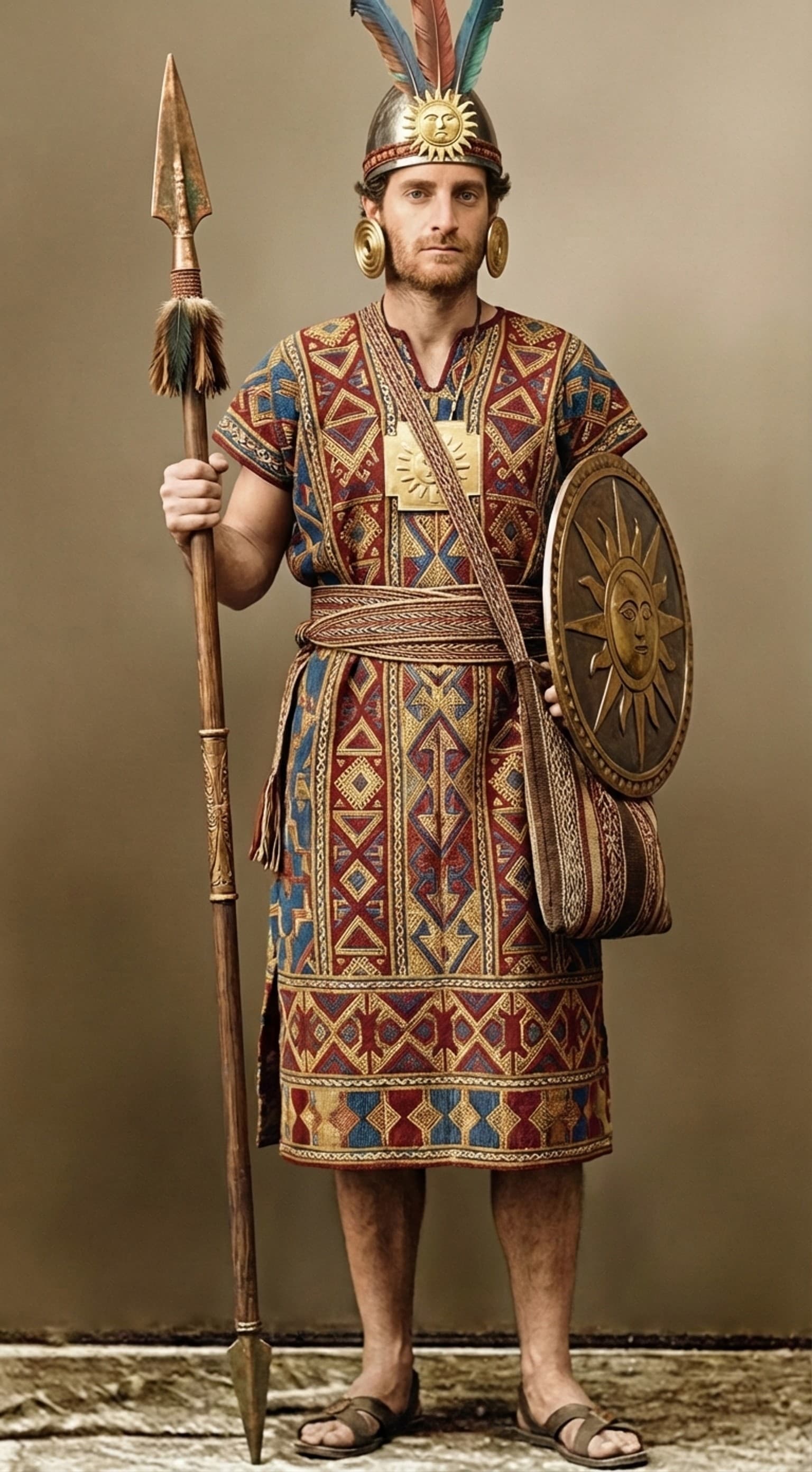
Uniform and equipment
| Uniform | Finely woven tunics in geometric royal patterns |
|---|---|
| Dress uniform | Brightly colored garments, heavy gold adornments |
| Headgear | Mascapaycha royal fringe headdress |
| Equipment | Sling, spear, club (macana), axes |
| Insignia and standard | Mascapaicha crimson forehead fringe |
Service record
| First appeared | 1400s |
|---|---|
| Peak strength | ~1,000 warriors |
| Recruited from | Orejobes (Nobles) |
| Primary tactic | Bodyguard Defense |
| Signature engagement | Battle of Cajamarca (1532) |
| Motto or battle cry | Haylli! (Victory/Triumph) |
| Obsolescence | Spanish Conquest |
Timeline
- 1438: Imperial Reformation. Pachacuti Inca Yupanqui formalizes the structure of the imperial armies and the elite bodyguard units.
- 1527: Civil War Outbreak. The death of Huayna Capac splits the loyalty of the Guard between the northern veterans (Atahualpa) and the Cusco elite (Huáscar).
- 1532: Massacre at Cajamarca. The Royal Guard is decimated protecting Atahualpa; the Empire is effectively decapitated.
- 1536: Siege of Cusco. Remnants of the Guard under Manco Inca lay siege to the Spanish-held capital for ten months.
- 1572: Fall of Vilcabamba. The last stronghold falls; the final remnants of the Royal Guard die defending Túpac Amaru, marking the end of the unit.
Battles
Battle of Quipaipan
The decisive clash of the Inca Civil War. The Royal Guard, hardened by northern campaigns, shattered the levies of Huáscar in a bloody rout, seizing the capital and securing Atahualpa's claim to the crimson fringe before the Spanish arrival.
Battle of Cajamarca
A catastrophic ambush. Unarmed for a ceremonial meeting, the Royal Guard surrounded the Sapa Inca's litter. They threw themselves onto Spanish swords and horses, using their bodies as shields. Thousands died without breaking rank, the last line of defense for their god-king.
Battle of Ollantaytambo
Under Manco Inca, the reorganized Guard utilized high terraces and flooded plains to neutralize Spanish cavalry. From their stone fortress, they rained arrows and stones upon the invaders, forcing a rare and humiliating Spanish retreat.
Commanders
Chalcuchimac
The hammer of the Inca armies, known for his brutal efficiency and unyielding loyalty to Atahualpa. He orchestrated the capture of Huáscar but was later deceived by Pizarro. He was burned alive by the Conquistadors, refusing to convert or betray his gods until the bitter end.
Quizquiz
A relentless tactician and Atahualpa's most loyal general. He commanded the veteran legions of the north, crushing Huáscar's forces in the Civil War. Even after the collapse at Cajamarca, he fought a desperate rearguard war against the Spanish cavalry until his assassination by mutinous troops.
Tactics
The Human Wall
In the presence of the Sapa Inca, the Guard formed a tight, suicidal perimeter around the royal litter. If a bearer fell, a guard immediately took their place, ensuring the King never touched the ground, even while being slaughtered.
Terrace Ambush
Exploiting the Andean terrain, the unit would lure enemies into narrow valley floors before unleashing a plunging barrage of sling stones and boulders from fortified agricultural terraces.
Shock and Smash
After softening the enemy with slings, the Guard would charge in a disciplined phalanx, using the heavy 'Champi' maces to shatter bones and incapacitate enemies for capture.