
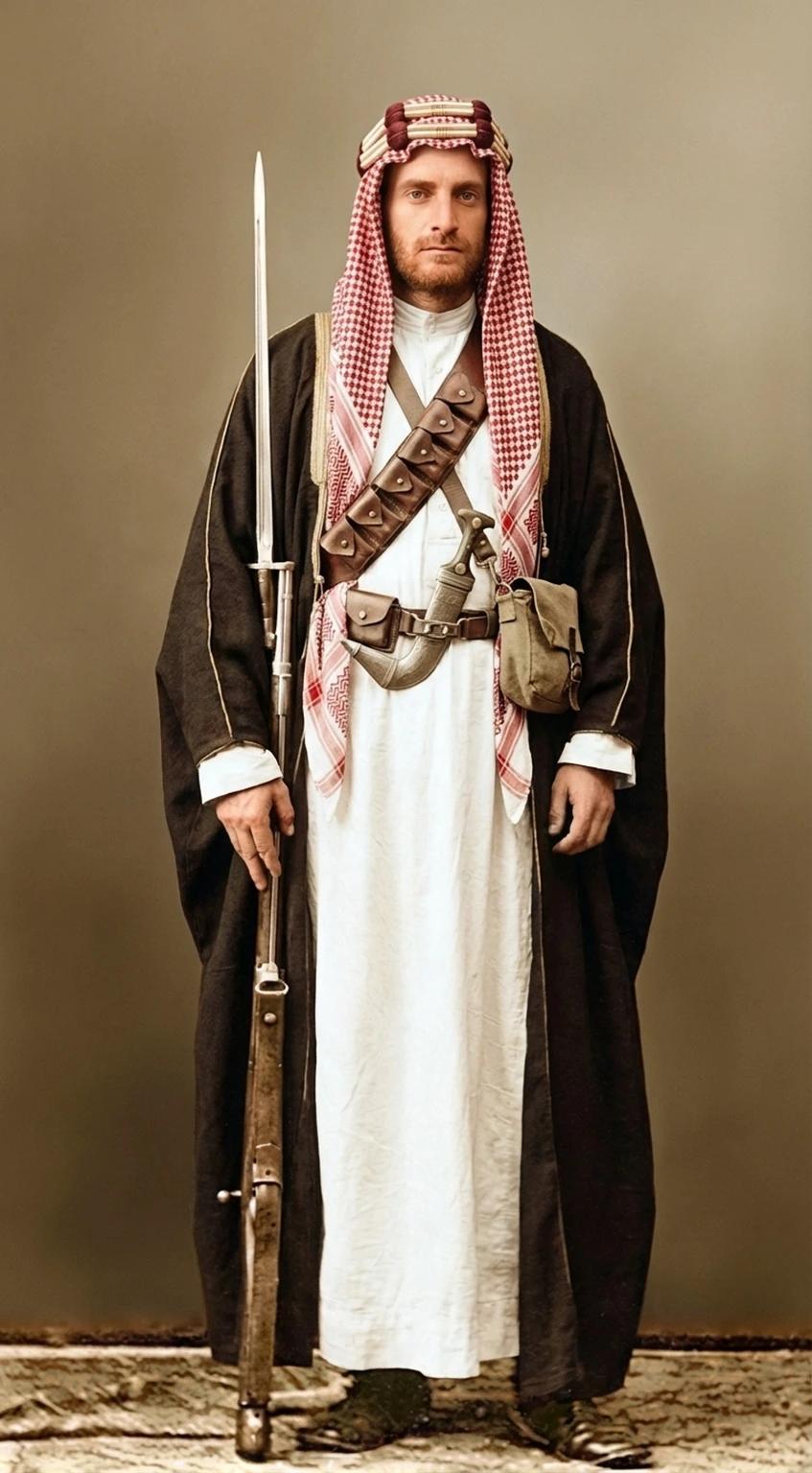
Uniform and equipment
| Uniform | Traditional robes, bandoliers |
|---|---|
| Dress uniform | N/A |
| Headgear | Keffiyeh |
| Equipment | Lee-Enfield, dagger, explosives |
| Insignia and standard | Arab Revolt flag (black/green/white stripes, red hoist triangle) |
Service record
| First appeared | 1916 |
|---|---|
| Peak strength | 30,000 |
| Recruited from | Bedouin Tribesmen |
| Primary tactic | Desert Raid / Sabotage |
| Signature engagement | Battle of Aqaba (1917) |
| Motto or battle cry | Awfi! (Make good!) |
| Obsolescence | End of WWI |
Timeline
- 1916: The Revolt Begins. Sharif Hussein bin Ali proclaims the Arab Revolt in Mecca, attacking the Ottoman garrison.
- 1917: Capture of Wejh. Faisal's forces take the Red Sea port of Wejh, turning it into a primary base for operations against the railway.
- 1917: Fall of Aqaba. Auda ibu Tayi and Lawrence lead the daring inland strike to capture the strategic port.
- 1918: Megiddo Offensive. Irregulars sever key communication lines around Deraa, facilitating Allenby's breakthrough in Palestine.
- 1918: Entry into Damascus. Arab forces enter Damascus, establishing a short-lived Arab administration.
Battles
Battle of Aqaba
A masterstroke of guerrilla warfare. Crossing the 'impassable' Nefud desert to strike the Ottoman rear, the irregulars seized the port city, securing a supply line for the British and ending the threat to the Suez Canal.
Capture of Damascus
The culmination of the Revolt. Arab forces raced British cavalry to the city, entering first to establish an Arab government, marking the symbolic end of 400 years of Ottoman rule in the Levant.
Battle of Tafileh
A rare defensive engagement where Lawrence and Prince Zeid commanded irregulars in a conventional battle, decimating an Ottoman column using terrain and automatic weapons to shatter the enemy advance.
Commanders
Auda ibu Tayi
The 'River of God' and chief of the Howeitat. A warrior of mythical proportions who claimed to have killed 75 men with his own hands. His ferocity and knowledge of the desert were instrumental in the impossible crossing of the Nefud to take Aqaba.
Faisal I bin Al-Hussein
The tactical and political heart of the Revolt. A pragmatic visionary, Faisal united fractured Bedouin tribes into a cohesive fighting force, balancing tribal feuds while coordinating with British intelligence to drive the Ottomans from the Hejaz.
T.E. Lawrence
Known as 'Lawrence of Arabia,' this British liaison embraced Bedouin culture to become a master of asymmetric warfare. He engineered the strategy of crippling infrastructure rather than engaging in pitched battles, earning the deep respect of the tribes.
Tactics
Railway Sabotage
Using 'tulip' mines to twist rails and destroy rolling stock, forcing the Ottomans to garrison thousands of troops along the Hejaz Railway rather than the front lines.
Ghazw (Raiding)
Adapting traditional tribal raiding to modern war: striking isolated outposts or columns with overwhelming speed and vanishing into the deep desert before reinforcements could arrive.
Deep Desert Envelopment
Navigating terrain considered impassable by modern armies to attack the enemy's undefended rear, as demonstrated at Aqaba.