
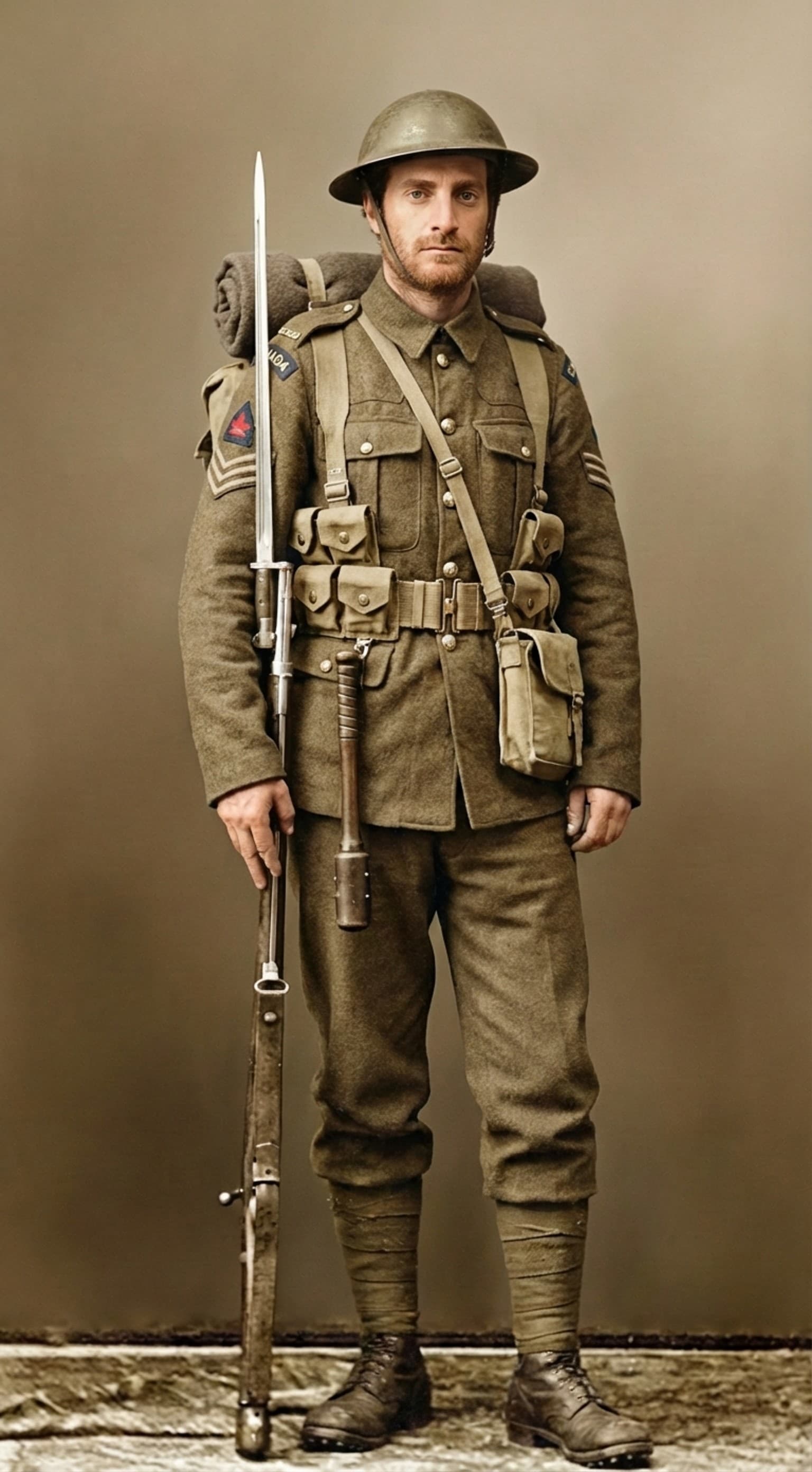
Uniform and equipment
| Uniform | Khaki, Ross Rifle (early) or SMLE |
|---|---|
| Dress uniform | N/A |
| Headgear | Brodie Helmet or Service Cap |
| Equipment | SMLE, grenades |
| Insignia and standard | Colored battle patches (geom shapes) for division/battalion |
Service record
| First appeared | 1915 |
|---|---|
| Peak strength | Canadian Corps |
| Recruited from | Volunteers / Conscripts |
| Primary tactic | Creeping Barrage Assault |
| Signature engagement | Battle of Vimy Ridge (1917) |
| Motto or battle cry | For the Empire! (or Battalion mottos) |
| Obsolescence | End of WWI |
Timeline
- 1914: Formation at Valcartier. The Canadian Expeditionary Force is hastily assembled, training 30,000 volunteers in Quebec before shipping out.
- 1915: Baptism of Fire at Ypres. The 1st Canadian Division faces gas and holds the line, establishing their reputation as elite shock troops.
- 1916: The Somme Grinder. Canadians suffer heavy losses at Beaumont-Hamel and Courcelette but introduce the tank to the battlefield.
- 1917: Vimy Ridge. The Corps fights as a unified national entity for the first time, seizing the high ground in a masterclass of planning.
- 1918: Canada's Hundred Days. The Corps acts as the spearhead for the Allied advance, breaking the Hindenburg Line and pushing to Mons.
- 1919: Demobilization. The victorious but weary troops return home to a nation forever changed by their sacrifice.
Battles
Second Battle of Ypres
Facing the first large-scale chlorine gas attack in history, the Canadians held the line while French colonial troops on their flank collapsed. They urinated on handkerchiefs to filter the poison, earning a reputation for grim tenacity.
Battle of Vimy Ridge
Through sleet and snow, all four Canadian divisions attacked in unison. Following a perfectly timed creeping barrage, they stormed the 'impregnable' German fortress, achieving one of the war's greatest tactical victories.
Battle of Passchendaele
Ordered to take a ridge drowning in liquid mud, the Corps succeeded where others failed, but at a staggering cost of 15,654 casualties. It was a victory of sheer will against an apocalyptic landscape.
Battle of Amiens
Spearheading the Hundred Days Offensive, the Canadians smashed through German lines in a combined-arms assault. General Ludendorff called it 'the black day of the German Army,' signaling the beginning of the end.
Commanders
Sir Arthur Currie
A meticulous planner who rose from militia gunner to command the Canadian Corps. He refused to treat soldiers as cannon fodder, perfecting the 'set-piece' attack and artillery coordination that made the Canadians the vanguard of the final victory.
Julian Byng
The British aristocrat who first molded the Canadians into a unified fighting force. He instilled discipline and self-belief, famously stating, 'I am proud of you,' after the victory at Vimy Ridge before handing command to Currie.
Andrew McNaughton
A brilliant scientist-soldier who revolutionized counter-battery fire. His methods of sound-ranging and flash-spotting allowed Canadian artillery to silence German guns before the infantry went over the top.
Tactics
The Creeping Barrage
A moving curtain of artillery fire that advanced just ahead of the infantry (100 yards every 3 minutes), forcing the enemy to stay underground until the Canadians were on top of them.
Trench Raiding
Small, heavily armed groups would infiltrate enemy lines at night to capture prisoners, destroy defenses, and maintain psychological dominance over the Germans.
Counter-Battery Fire
Using scientific methods to locate enemy guns, the Canadians would systematically destroy German artillery before an assault, ensuring the infantry could advance without being shelled.
Platoon Initiative
Unlike rigid formations, Canadian platoons contained their own specialists (Lewis gunners, rifle-grenadiers, bombers) allowing them to maneuver and take out strongpoints independently.