
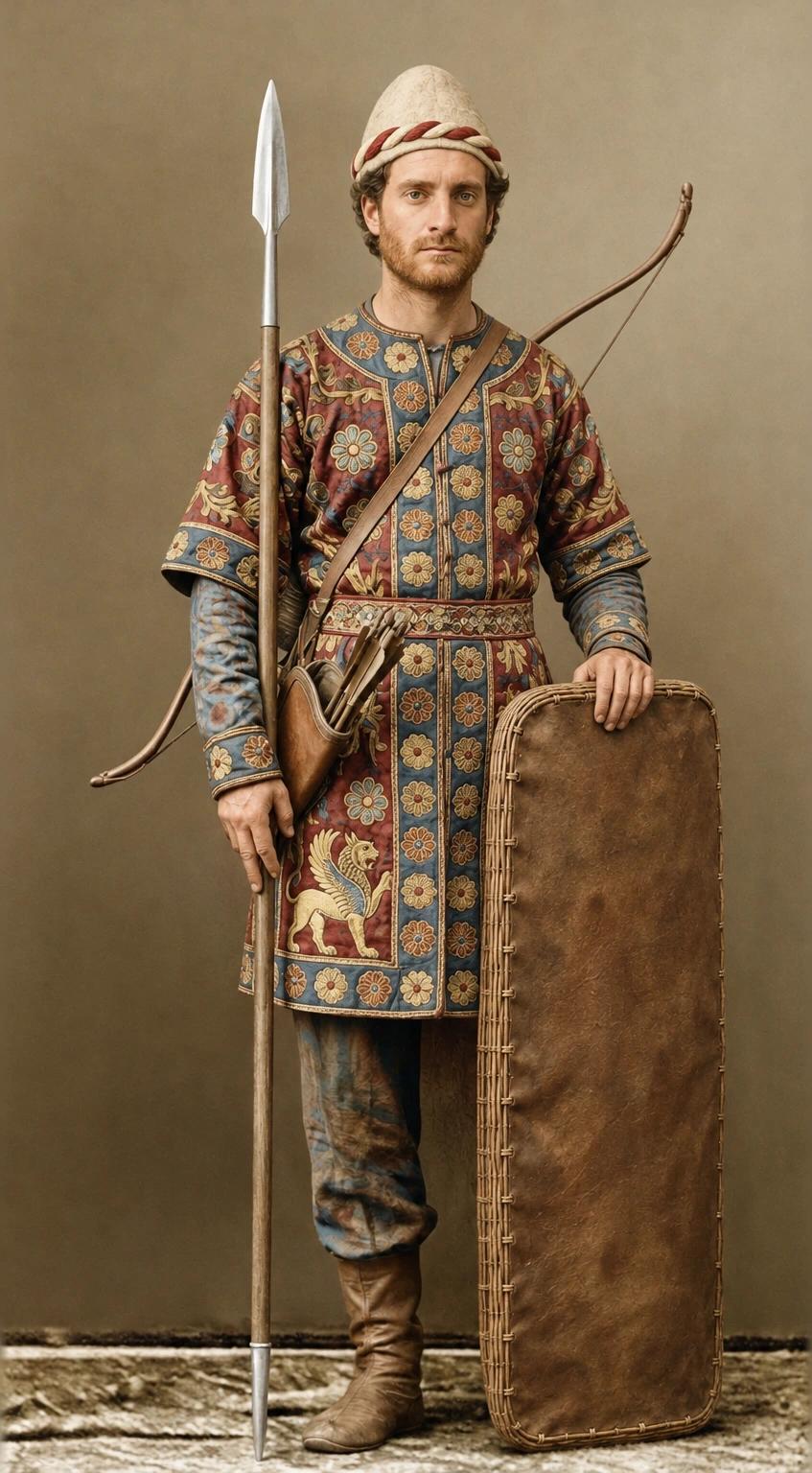
Uniform and equipment
| Uniform | Colorful patterned robes over scale armor, trousers, soft shoes |
|---|---|
| Dress uniform | Embroidered robes in royal colors, gilded scale corselet, ornate belts |
| Headgear | Soft tiara-like kidaris cap with colored band |
| Equipment | Short spear, wicker shield, akinakes short sword, bow and quiver |
| Insignia and standard | Shahbaz (golden falcon) or winged disc standard |
Service record
| First appeared | c. 550 BC |
|---|---|
| Peak strength | 10,000 men |
| Recruited from | Persian and Median Nobility |
| Primary tactic | Archery Barrage followed by Spear |
| Signature engagement | Battle of Thermopylae (480 BC) |
| Motto or battle cry | For the King of Kings |
| Obsolescence | Macedonian Phalanx Tactics |
Timeline
- 550 BC: Formation. Cyrus the Great establishes the corps as a standing professional army to unify the Persian tribes.
- 525 BC: Egyptian Campaign. The unit proves its expeditionary capability during the conquest of Egypt under Cambyses II.
- 480 BC: Invasion of Greece. The Immortals serve as the tip of the spear for Xerxes, seeing heavy action at Thermopylae.
- 479 BC: Devastation at Plataea. The core of the unit is wiped out by Spartan hoplites; the unit is later reconstituted but loses its aura of invincibility.
- 330 BC: Dissolution. Following the fall of the Achaemenid Empire to Alexander, the unit is disbanded and replaced by Macedonian structures.
Battles
Battle of Gaugamela
The final stand of the old guard. Facing Alexander the Great, the remaining royal guards (Apple Bearers) fought to protect Darius III but were ultimately swept aside by the Macedonian cavalry charge, marking the end of the Achaemenid era.
Battle of Plataea
The Immortals fought with desperate courage against the Spartan heavy infantry. Despite their superior numbers and skill, their wicker shields and shorter spears could not penetrate the bronze panoply of the hoplites, leading to the destruction of the Persian elite.
Battle of Thermopylae
Initially stymied by the phalanx in the narrow pass, the Immortals executed a grueling night march through the mountains. They descended upon the Greek rear at dawn, crushing the Spartan resistance and opening the road to Athens.
Battle of Pelusium
Under Cambyses II, the Immortals spearheaded the assault that broke the Egyptian army. Utilizing psychological warfare and superior archery, they decimated the Pharaoh's forces, bringing Egypt under Achaemenid rule.
Commanders
Hydarnes
A loyal satrap and tactical pragmatist, Hydarnes commanded the Immortals during Xerxes' invasion of Greece. He famously led the unit through the Anopaea path to outflank the Spartans at Thermopylae, turning a grinding stalemate into a decisive strategic victory.
Mardonius
Xerxes' cousin and a brilliant, aggressive general. While commander of the entire invasion force, he personally led the elite infantry corps at Plataea. He died fighting furiously on horseback, surrounded by the Immortals who refused to retreat until their leader fell.
Tactics
The 10,000 Count
Psychological warfare where casualties were immediately replaced from reserves, giving the illusion that the unit was immortal and undiminished.
Arrow Storm
Initiating combat with a massive, coordinated volley of arrows from behind a shield wall to disrupt enemy formations before contact.
Combined Arms Switch
Seamlessly transitioning from archers to spearmen; the front ranks braced shields while rear ranks fired, then all drew steel for the charge.