
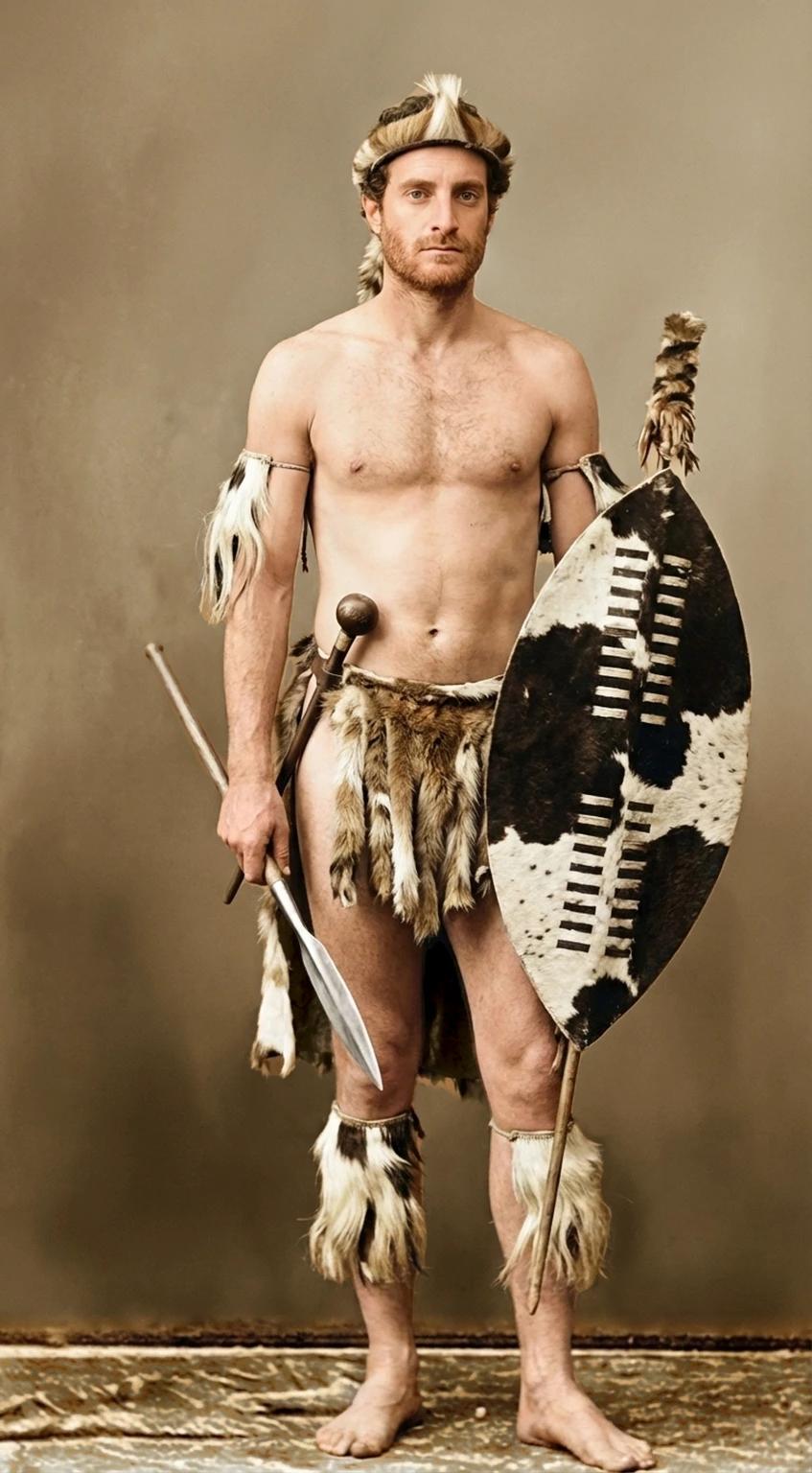
Uniform and equipment
| Uniform | Cowhide shields (color coded), feathers/furs |
|---|---|
| Dress uniform | Ceremonial furs |
| Headgear | Headring (Isicoco) for married men |
| Equipment | Iklwa (short stabbing spear), knobkerrie, shield |
| Insignia and standard | Cowhide shield color pattern |
Service record
| First appeared | 1816 |
|---|---|
| Peak strength | 40,000+ men |
| Recruited from | Age-Grade Regiments (Amabutho) |
| Primary tactic | Horns of the Buffalo (Encirclement) |
| Signature engagement | Battle of Isandlwana (1879) |
| Motto or battle cry | Usuthu! (War Cry) |
| Obsolescence | British Conquest / Machine Guns |
Timeline
- 1816: Ascension of Shaka. Shaka takes control of the Mthethwa Confederacy and begins transforming the Zulu tribe into a militaristic state.
- 1818: Military Reforms. Introduction of the Iklwa, removal of sandals for barefoot conditioning, and the first successful use of the Buffalo tactics.
- 1828: Death of Shaka. Shaka is assassinated by his half-brothers; the military system remains intact under Dingane.
- 1838: Battle of Blood River. A disastrous defeat against Boer commandos, highlighting the vulnerability of the Impi to concentrated firepower from wagon laagers.
- 1873: Coronation of Cetshwayo. Cetshwayo rebuilds the army's strength, amassing over 40,000 warriors in organized amabutho (regiments).
- 1879: Anglo-Zulu War. The Impi faces the British Empire, achieving a legendary victory at Isandlwana before ultimate defeat at Ulundi.
Battles
Battle of Gqokli Hill
Shaka's tactical debut against the superior Ndwandwe force. By utilizing the terrain and the 'Horns of the Buffalo' formation for the first time, he turned a defensive stand into a slaughter, cementing his rise to power.
Battle of Isandlwana
The Impi's greatest triumph. 20,000 warriors overran a British camp armed with modern rifles and artillery. Despite taking heavy casualties, their relentless discipline allowed them to close the distance and wipe out the invaders.
Battle of Ulundi
The end of the old order. The British formed a hollow square with Gatling guns. The Impi charged with suicidal courage but could not break the wall of lead, marking the effective end of Zulu military power.
Battle of Rorke's Drift
A gritty testament to Zulu bravery. The reserve 'loins' of the army defied orders and attacked a fortified station. They charged repeatedly into point-blank volley fire for twelve hours before finally withdrawing.
Commanders
Shaka kaSenzangakhona
The illegitimate son who forged an empire. Shaka revolutionized tribal warfare by introducing the short stabbing spear, discarding sandals for speed, and drilling his men into a unified, lethal machine. His ruthlessness created the Zulu identity.
Ntshingwayo kaMahole Khoza
The tactical mastermind behind the victory at Isandlwana. A trusted induna of King Cetshwayo, he managed to conceal an army of 20,000 men in a ravine, unleashing them with terrifying speed to encircle and annihilate the British column.
Cetshwayo kaMpande
The last king of an independent Zulu nation. Though he sought peace, he mobilized the entire male population when war became inevitable, maintaining the discipline and structure Shaka had built decades prior.
Tactics
Izimpondo zankomo (Horns of the Buffalo)
The signature encirclement maneuver. The 'Chest' engages the enemy head-on, while the 'Horns' sprint to flank and surround them. The 'Loins' sit in reserve with backs to the battle to remain calm until called.
Shock Action
Abandoning the traditional skirmishing with throwing spears, the Impi was trained to close distance rapidly under fire to engage in brutal hand-to-hand combat with the stabbing spear.
Strategic Mobility
Warriors were conditioned to run barefoot for up to 50 miles a day across rough terrain, allowing them to outmaneuver enemies and strike before defenses could be prepared.