
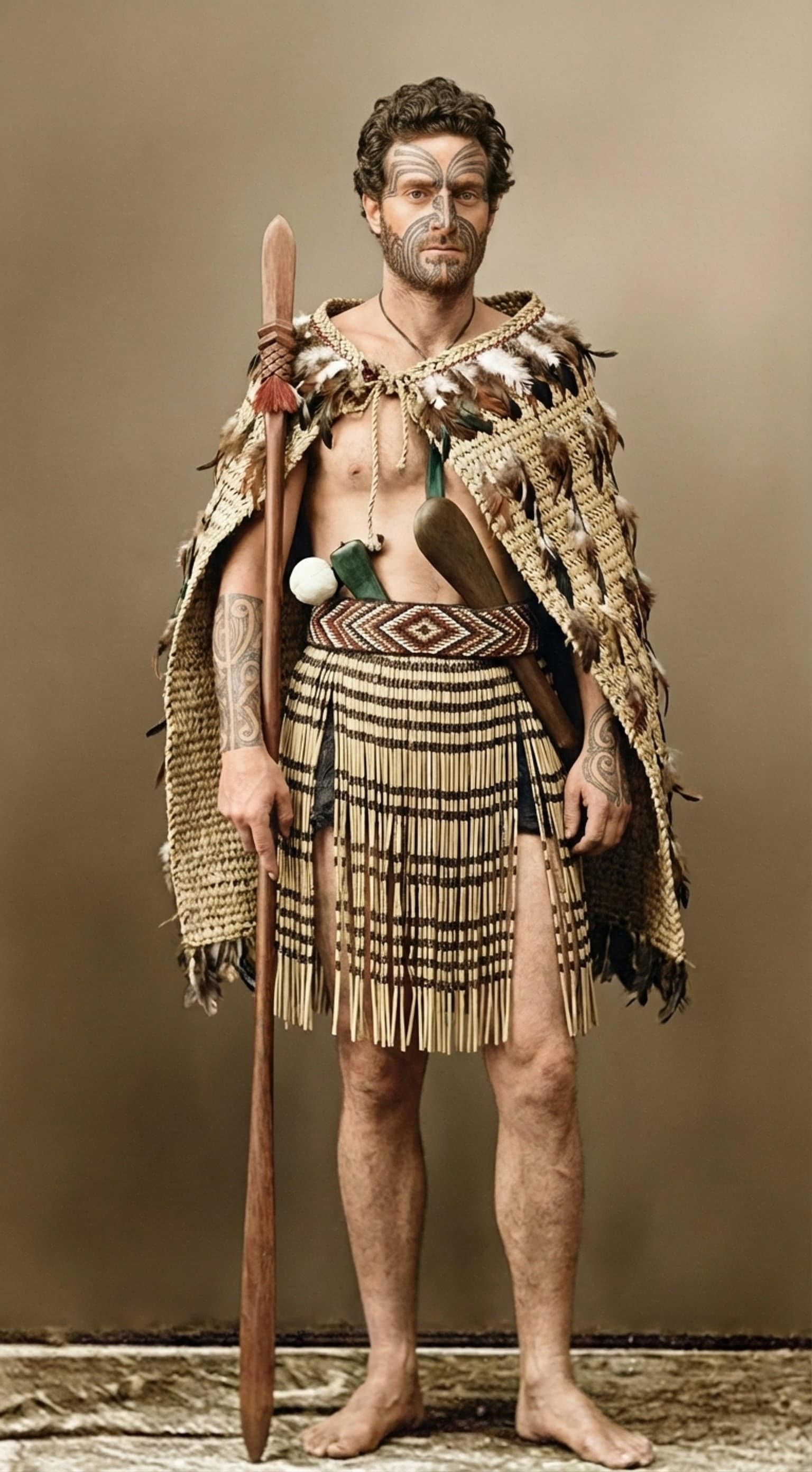
Uniform and equipment
| Uniform | Traditional dress, later western clothes |
|---|---|
| Dress uniform | Cloaks, tattoos (Moko) |
| Headgear | Feathers |
| Equipment | Mere (club), Taiaha (staff), musket |
| Insignia and standard | Tā Moko facial tattoos as crest |
Service record
| First appeared | 1300s |
|---|---|
| Peak strength | Tribal war parties |
| Recruited from | Tribal Warriors |
| Primary tactic | Trench Warfare / Ambush |
| Signature engagement | Gate Pā (1864) |
| Motto or battle cry | Ka Mate! Ka Mate! (I die! I die! - Haka) |
| Obsolescence | Integration |
Timeline
- 1807: Beginning of the Musket Wars. Inter-tribal conflicts escalate drastically as iwi (tribes) acquire European firearms, changing Maori warfare forever.
- 1845: The Flagstaff War. Hone Heke cuts down the British flagstaff, signaling the start of the Northern War and the debut of anti-artillery Pā tactics.
- 1860: First Taranaki War. Disputes over land sales ignite conflict in Taranaki, showcasing the Toa's ability to utilize terrain against regulars.
- 1863: Invasion of the Waikato. The Governor orders the invasion of the Kingitanga heartland; the Maori construct the defensive Meremere line.
- 1864: Battle of Gate Pā. The zenith of Maori military engineering, inflicting one of the heaviest defeats on British forces in the 19th century.
- 1872: End of Te Kooti's War. The conclusion of the major New Zealand Wars campaigns, marking the end of large-scale armed resistance.
Battles
Battle of Ruapekapeka
The first true 'Gunfighter Pā'. Kawiti's engineers built a fortress of zig-zag trenches and bomb-proof shelters that rendered British cannon fire useless. The British captured an empty fort after the Maori tactically withdrew.
Battle of Gate Pā (Pukehinahina)
Outnumbered Toa withstood a massive British artillery bombardment by hiding in anti-artillery bunkers. When the British stormed the breach, the warriors emerged from the earth, decimating the officers in close quarters before vanishing into the night.
Siege of Orakau
Rewi's Last Stand. Surrounded with no water and low ammunition, 300 warriors held off 1,400 soldiers for three days. Though defeated, their breakout charge through British lines remains a legendary act of defiance and courage.
Commanders
Rewi Maniapoto
A defiant strategist of the Kingitanga movement. Famous for his refusal to surrender at Orakau with the cry 'Ka whawhai tonu mātou, Ake! Ake! Ake!' (We will fight on forever and ever). He mastered the defense of the Pā against superior British numbers.
Te Rauparaha
Known as the 'Napoleon of the South', he was a brilliant tactician who composed the famous 'Ka Mate' haka. He leveraged early musket acquisition to migrate his tribe and conquer vast territories, blending traditional ferocity with modern firepower.
Titokowaru
A prophet and war chief who led a stunningly successful guerrilla campaign in Taranaki. He utilized spiritual mana and military genius to inflict humiliating defeats on colonial forces, mastering the art of the tactical withdrawal and ambush.
Tactics
Gunfighter Pā
Revolutionary earthworks featuring zig-zag trenches to stop enfilade fire, underground bunkers to survive artillery, and deceptive outer fences to lure enemies into kill zones.
Haka Peruperu
A war dance performed with weapons before battle to unify the warriors' breath and spirit, and to psychologically terrorize the enemy with bulging eyes and protruding tongues.
Kokiri (The Rush)
A sudden, overwhelming charge from cover. Warriors would discharge firearms at close range before switching to mere or patu for brutal hand-to-hand combat.
Bush Ambush
Exploiting the dense native forest to negate British formation drilling, using knowledge of the terrain to strike supply lines and isolated patrols.