
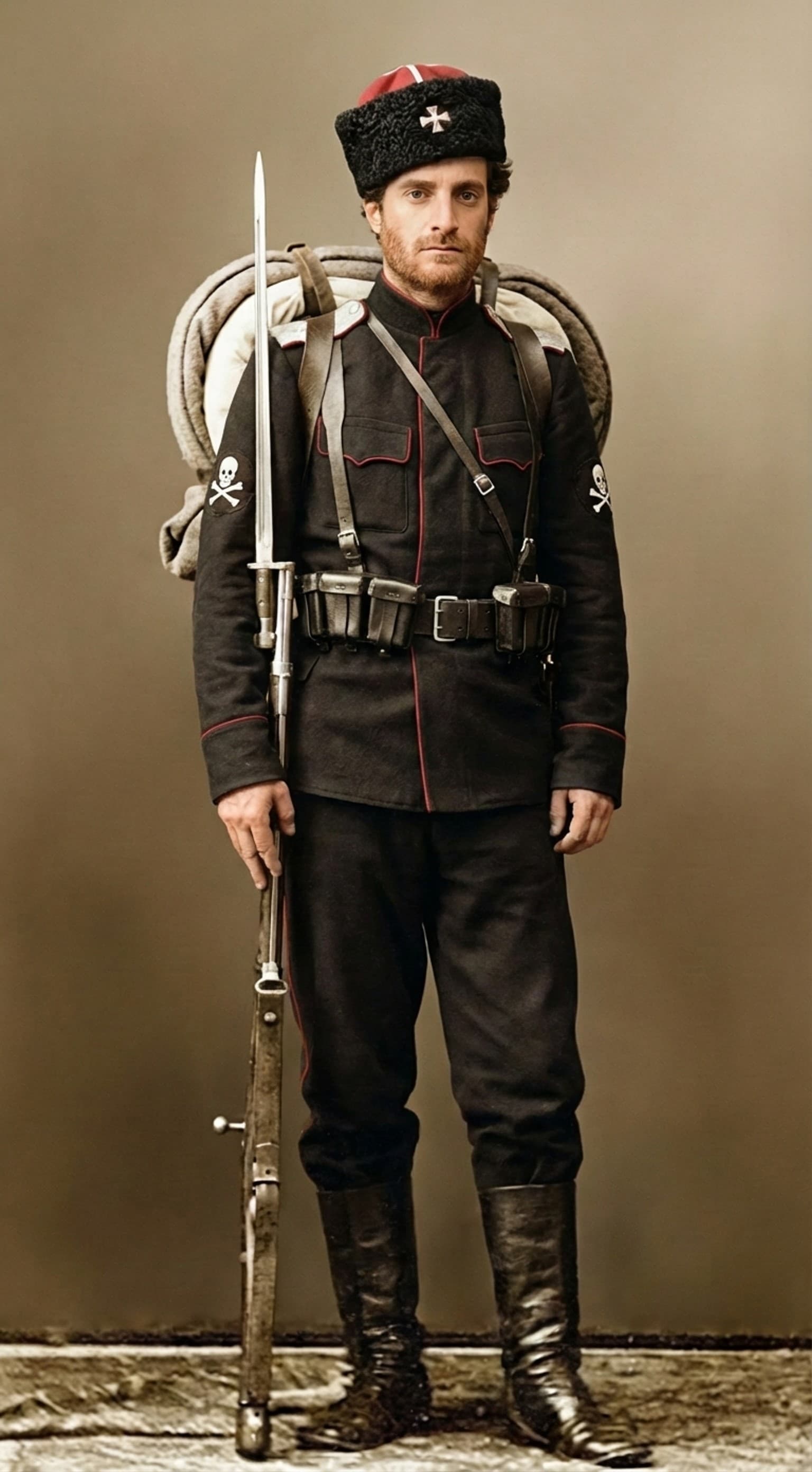
Uniform and equipment
| Uniform | Black uniforms, death's head patch |
|---|---|
| Dress uniform | N/A |
| Headgear | Peaked cap |
| Equipment | Rifle, Lewis gun |
| Insignia and standard | Red/black chevron sleeve and skull patch |
Service record
| First appeared | 1917 |
|---|---|
| Peak strength | Battalions |
| Recruited from | Officers / Students |
| Primary tactic | Psychological Attack (No prisoner) |
| Signature engagement | Ice March (1918) |
| Motto or battle cry | Za Rossiyu (For Russia) |
| Obsolescence | Defeat in Civil War |
Timeline
- 1917: Formation of Shock Battalions. Originally formed as 'Death Battalions' to stiffen resolve in WWI, these units reorganize as the core of the anti-Bolshevik Volunteer Army.
- 1918: The Ice March. The unit retreats from Rostov across the frozen Kuban steppe, engaging in constant combat while outnumbered.
- 1919: The Moscow Directive. General Denikin orders a general advance on Moscow; Shock units lead the spearhead, taking Kursk and Orel.
- 1920: Defense of Perekop. The remnants of the Shock regiments hold the Crimean bottleneck against the Red Army to allow evacuation.
- 1920: Gallipoli Evacuation. The unit leaves Russian soil from Crimea, entering exile and transforming into a military society abroad.
Battles
The Ice March (First Kuban Campaign)
A legendary 80-day trek across frozen steppes. 4,000 volunteers, surrounded by Red forces, marched through snow and mud. Though Kornilov was killed, the army survived specifically due to the ferocity of the Shock units, forging the core legend of the White movement.
Second Battle of Yekaterinodar
Following the disastrous first attempt, the Volunteer Army returned with a vengeance. Using rapid maneuver and shock tactics, they stormed the Red stronghold, securing a capital for the White movement in South Russia and capturing vast supplies.
Orel-Kromy Operation
The high-water mark of the White advance on Moscow. The Shock divisions spearheaded the assault, capturing Orel, but were overextended. Facing overwhelming Red numbers and Latvian Riflemen, they were forced to retreat, signaling the turning point of the war.
Commanders
Mikhail Drozdovsky
A staunch monarchist who led a miraculous 1,200km march from the Romanian front to join the Volunteer Army. His arrival provided critical reinforcements that saved the White movement from early annihilation. He died of gangrene following a minor wound.
Lavr Kornilov
A charismatic and fearless general who founded the Volunteer Army. Idolized by his men, he embodied the unyielding spirit of the White resistance. He led the initial desperate campaigns in the Don before being killed by a shell in 1918, becoming a martyr for the cause.
Sergei Markov
A tactical genius and legend of the Ice March. Known for his personal bravery and the 'Markovite' psychological attack—marching silently into enemy fire. He commanded the Officer's Regiment and saved the army from encirclement multiple times before his death in battle.
Tactics
Psychological Attack
Units marched upright in full view of the enemy without firing or taking cover, silent until close range, then charging with bayonets. This terrified ill-disciplined Red conscripts.
Officer Concentration
Unlike Red units, White Shock battalions were often composed entirely of officers serving as privates, resulting in exceptionally high morale, marksmanship, and tactical flexibility.
Railway War
Utilizing armored trains (Bronepoezd) as mobile artillery and battering rams to support infantry assaults along rail lines, seizing key junctions rapidly.