
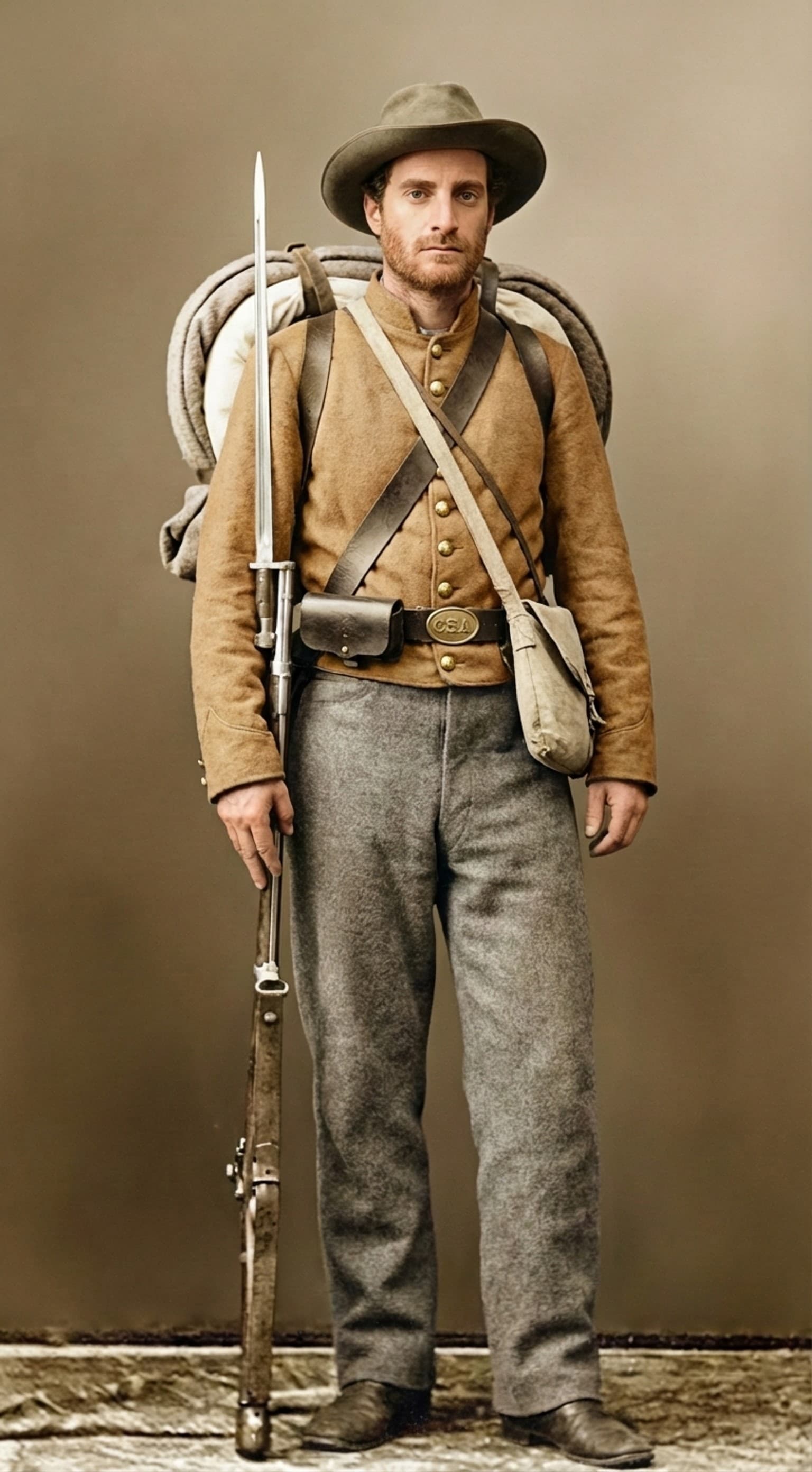
Uniform and equipment
| Uniform | Grey/Butternut various uniforms |
|---|---|
| Dress uniform | N/A |
| Headgear | Slouch hat or kepi |
| Equipment | Enfield rifle, bayonet |
| Insignia and standard | Southern Cross battle flag |
Service record
| First appeared | 1861 |
|---|---|
| Peak strength | Brigade strength |
| Recruited from | Virginians |
| Primary tactic | Flank March / Charge |
| Signature engagement | First Battle of Bull Run (1861) |
| Motto or battle cry | Rebel Yell! |
| Obsolescence | Casualties (Merged) |
Timeline
- 1861: Formation at Harpers Ferry. Jackson organizes the 2nd, 4th, 5th, 27th, and 33rd Virginia Infantry regiments into the First Brigade, Virginia Volunteers.
- 1861: Baptism at Manassas. The unit earns the moniker "Stonewall Brigade" for their stubborn defense at the First Battle of Bull Run.
- 1862: The Valley Campaign. The brigade executes a series of rapid marches and battles, defeating three Union armies and cementing the legend of the "Foot Cavalry."
- 1862: Stand at the Unfinished Railroad. At Second Manassas, the brigade holds the line until they run out of ammunition, resorting to throwing rocks at advancing Union troops.
- 1863: Loss of Jackson. Following Chancellorsville, the brigade mourns the death of their original commander, marking a decline in morale.
- 1864: Destruction at the Mule Shoe. The unit is shattered at Spotsylvania; the survivors are consolidated into a single small regiment for the remainder of the war.
- 1865: Surrender at Appomattox. Only 210 men of the original thousands remain to stack arms when Lee surrenders the Army of Northern Virginia.
Battles
First Battle of Bull Run
On Henry House Hill, amidst a collapsing Confederate line, the brigade held firm. General Bee shouted, "There stands Jackson like a stone wall!" rallying the troops. This defensive stand turned the tide of the war's first major engagement.
Battle of Chancellorsville
The brigade participated in Jackson's audacious flank march, shattering the Union XI Corps. However, in the confusion of twilight, they fired upon their own commander, Jackson, leading to his death—a blow from which the Army of Northern Virginia never recovered.
Battle of Spotsylvania Court House
At the "Bloody Angle," the brigade was overrun by a massive Union assault. Fighting hand-to-hand in rain-filled trenches, the unit suffered catastrophic casualties, effectively ceasing to exist as an independent fighting force.
Commanders
Charles S. Winder
A strict disciplinarian who struggled to win the affection of the men but commanded with immense bravery. He led the brigade effectively during the Seven Days Battles and was killed in action while directing artillery fire at Cedar Mountain.
James A. Walker
Known as "Stonewall Jim," he commanded the brigade during its final distinct phase. He led the desperate defense at the Bloody Angle in Spotsylvania, where he was severely wounded and the unit was effectively destroyed as an independent command.
Thomas J. "Stonewall" Jackson
An eccentric tactical genius whose iron discipline forged the brigade. At First Manassas, he stood immovable against the Union tide, earning the unit its name. He led them through the legendary Valley Campaign, utilizing speed and aggression until his death at Chancellorsville.
Tactics
Foot Cavalry March
Strategic mobility involving forced marches of up to 30 miles a day to achieve local numerical superiority before the enemy could react.
The Rebel Yell Charge
A high-pitched, unnerving scream used during assaults to intimidate the enemy and coordinate the psychological impact of the bayonet charge.
Defensive Anchor
The unit was often deployed to hold the most critical point of the line, absorbing enemy attacks to allow other units to maneuver.