
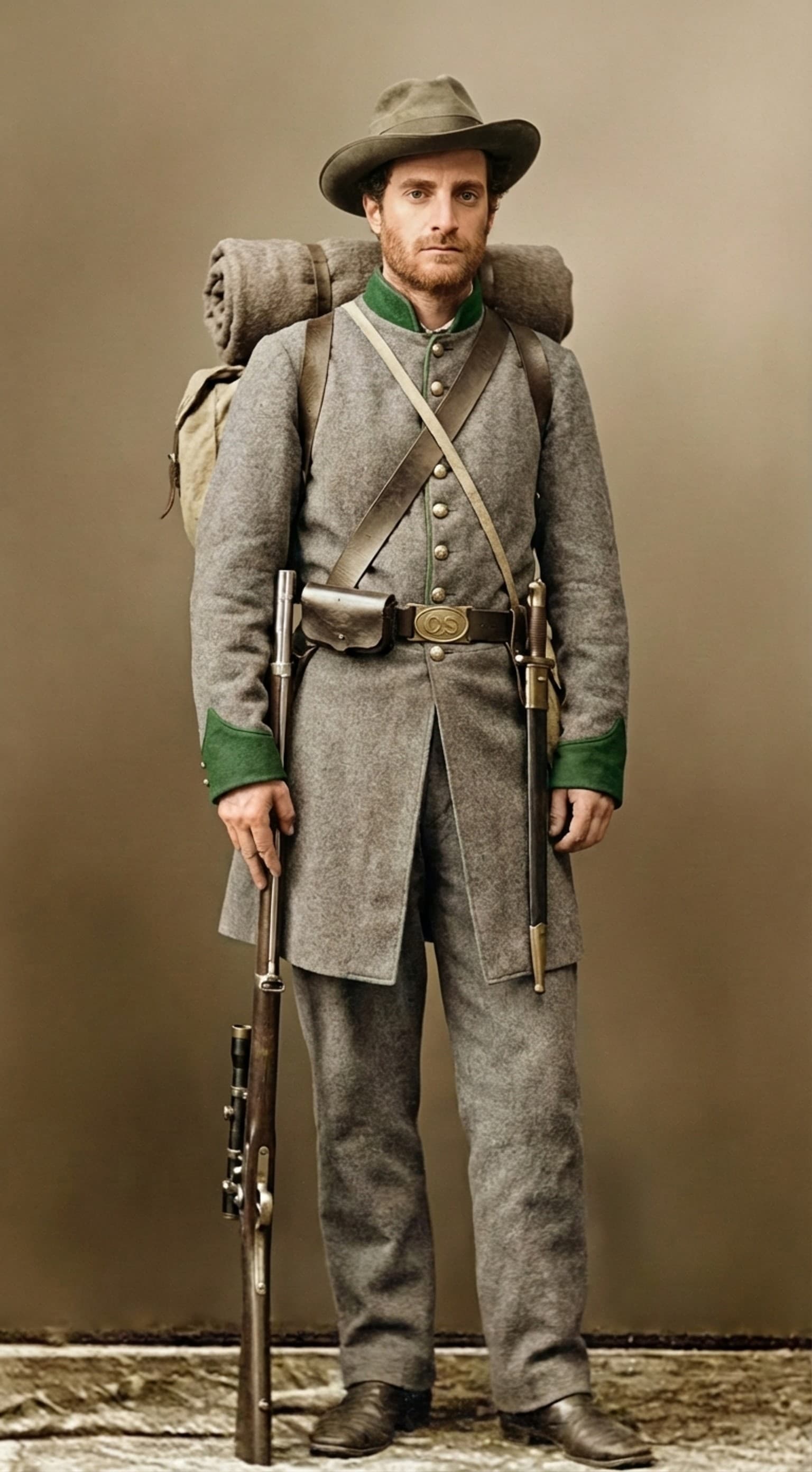
Uniform and equipment
| Uniform | Grey/Butternut, often distinct badge |
|---|---|
| Dress uniform | N/A |
| Headgear | Slouch hat |
| Equipment | Whitworth rifle (scoped) or Enfield |
| Insignia and standard | None (green collar only) |
Service record
| First appeared | 1862 |
|---|---|
| Peak strength | Battalions |
| Recruited from | Selected Marksmen |
| Primary tactic | Sniping / Skirmish Line |
| Signature engagement | Battle of Spotsylvania (1864) |
| Motto or battle cry | Deo Vindice (God our Vindicator) |
| Obsolescence | End of War |
Timeline
- 1862: Sharpshooter Act Passed. The Confederate Congress authorizes the recruitment of distinct battalions of sharpshooters for each brigade.
- 1863: Rodes' Reforms. General Robert Rodes organizes the first permanent sharpshooter battalions in the Army of Northern Virginia, instituting rigorous drill.
- 1863: Whitworth Deployment. Imported British Whitworth rifles begin arriving in small numbers, issued only to the finest marksmen.
- 1864: The Wilderness Campaign. Sharpshooters prove decisive in the dense brush, stalling Union advances and picking off officers.
- 1864: Death of Sedgwick. The most famous sniper shot of the war occurs at Spotsylvania, eliminating the highest-ranking Union casualty of the conflict.
- 1865: Appomattox Surrender. The remaining sharpshooter battalions surrender with Lee's army, their specialized rifles often smashed to prevent capture.
Battles
Battle of Chancellorsville
Sharpshooters led the vanguard of Stonewall Jackson's famous flank attack, silently neutralizing Union pickets to ensure total surprise before the main assault crashed into the Federal right.
Battle of Spotsylvania Court House
In a legendary display of marksmanship, a Confederate sniper killed Union General John Sedgwick from over 1,000 yards moments after Sedgwick claimed, 'They couldn't hit an elephant at this distance.'
Battle of Fort Stevens
During Early's raid, sharpshooters fired upon the parapets where President Lincoln stood observing, wounding a surgeon next to him and forcing the Commander-in-Chief to take cover.
Battle of Franklin
Despite a suicidal frontal assault by the main army, sharpshooters in the Western theater provided covering fire, though the battle resulted in the devastation of the Army of Tennessee.
Commanders
Robert E. Rodes
A warrior-engineer who pioneered the organization of dedicated sharpshooter battalions within the Army of Northern Virginia. He transformed loose skirmishers into a disciplined elite vanguard capable of independent action.
Eugene Blackford
Major of the 5th Alabama, Blackford was the tactical architect behind the elite sharpshooter battalion of Rodes' Division. He drilled his men relentlessly in range estimation and skirmish maneuvers.
Patrick Cleburne
Known as the 'Stonewall of the West,' Cleburne integrated sharpshooters armed with Whitworth rifles into his tactical doctrine, using them to suppress enemy artillery and pick off officers.
Tactics
Officer Targeting
Deliberately aiming for officers and NCOs to disrupt the enemy's chain of command and sow confusion.
Counter-Battery Fire
Suppressing enemy artillery by killing gunners and horses from a distance, often silencing guns without artillery support.
Skirmish Screening
Deploying in a loose, extended line ahead of the main infantry to harass the enemy and mask the army's movements.
Wolf Holes
Digging small, individual rifle pits for protection, allowing marksmen to hold ground against superior numbers.