
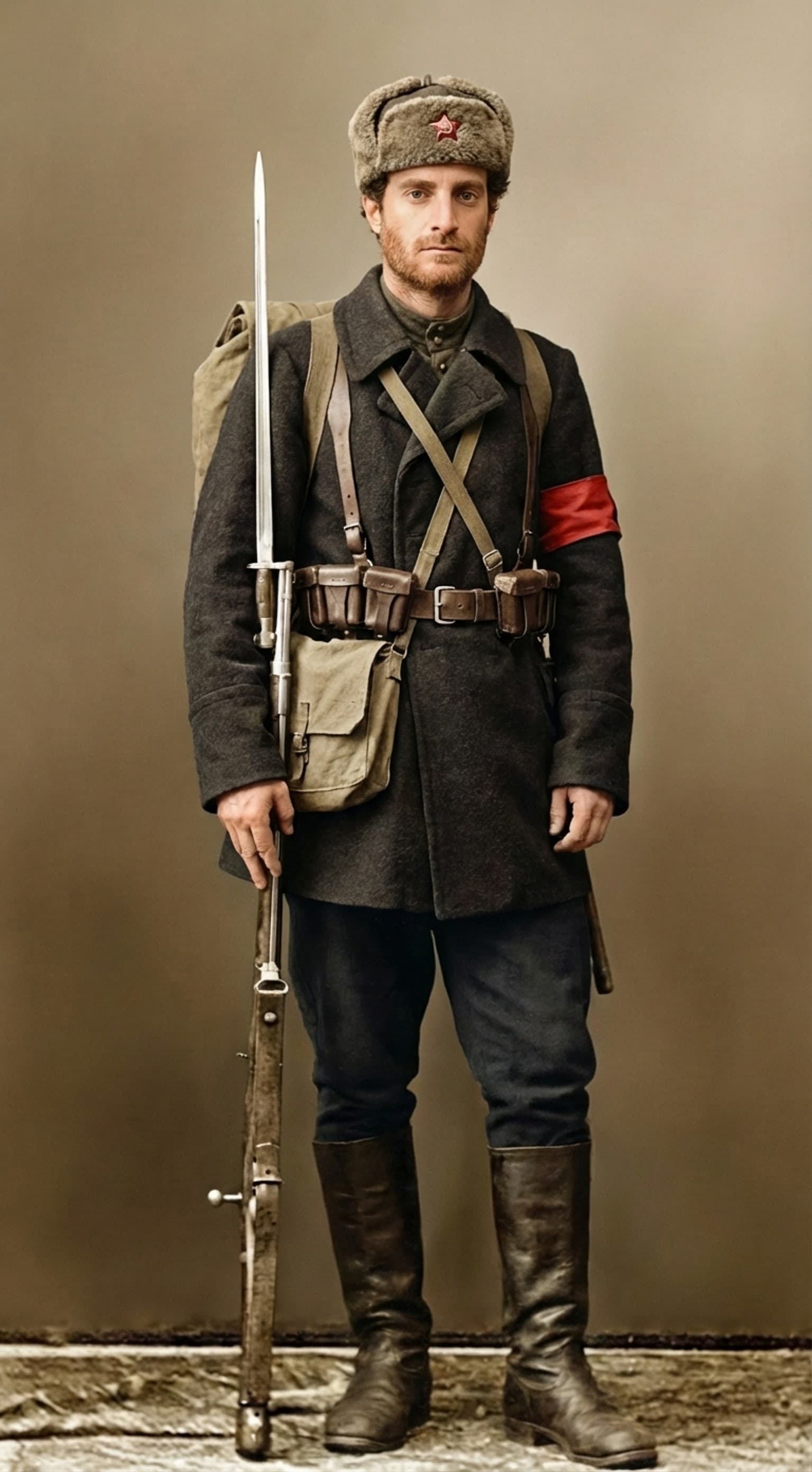
Uniform and equipment
| Uniform | Civilian clothes, red armband |
|---|---|
| Dress uniform | N/A |
| Headgear | Cap or Ushanka |
| Equipment | Mosin-Nagant, captured weapons |
| Insignia and standard | Red five-pointed star (pre-1922 plough/hammer variants) |
Service record
| First appeared | 1917 |
|---|---|
| Peak strength | 200,000 |
| Recruited from | Factory Workers |
| Primary tactic | Urban Insurrection |
| Signature engagement | Storming of the Winter Palace |
| Motto or battle cry | All Power to the Soviets! |
| Obsolescence | Merged into Red Army |
Timeline
- 1917: Formation of Factory Militias. Following the February Revolution, workers in Petrograd industrial districts form armed detachments to protect factories.
- 1917: Kornilov Affair. In August, the Provisional Government arms the Red Guards to defend Petrograd against a perceived right-wing coup, legitimizing the force.
- 1917: October Revolution. Red Guards seize key infrastructure (telegraphs, bridges, banks) in Petrograd, culminating in the capture of the Winter Palace.
- 1918: Decree on the Red Army. The Council of People's Commissars issues a decree forming the 'Workers' and Peasants' Red Army' to replace the irregular Guards.
- 1918: Integration and Disbandment. By April, the volunteer-based Red Guards are absorbed into the professionalized Red Army to fight the escalating Civil War.
Battles
Storming of the Winter Palace
The defining moment of the October Revolution. Red Guards, supported by Kronstadt sailors, infiltrated and seized the seat of the Provisional Government. Though less violent than mythologized, it was the decisive blow that birthed the Soviet state.
Battle of Pulkovo Heights
A chaotic but crucial defense where Red Guards and sailors halted General Krasnov's Cossacks. Lacking training but fueled by revolutionary zeal, they protected the nascent Bolshevik government from immediate counter-revolution.
Moscow Uprising
Unlike Petrograd, the fight for Moscow was a bloody, week-long urban siege. Red Guards battled military cadets (Junkers) street-by-street, eventually shelling the Kremlin to force a surrender.
Commanders
Konstantin Yurenev
Chairman of the General Staff of the Red Guard. He was instrumental in uniting the scattered armed workers' detachments of Petrograd into a centralized paramilitary organization prior to the October Revolution.
Vladimir Antonov-Ovseyenko
A fearless Bolshevik tactician who personally led the Red Guards during the storming of the Winter Palace. He famously arrested the Provisional Government ministers in the Malachite Room, signaling the end of the old order.
Leon Trotsky
The intellectual architect of the insurrection. As head of the Petrograd Soviet's Military Revolutionary Committee, he transformed disparate factory militias into a cohesive strike force capable of toppling the Provisional Government.
Tactics
Infrastructure Seizure
Prioritizing the capture of communication hubs, railway stations, and power plants to paralyze the government before firing a shot.
Urban Barricades
Constructing improvised defenses from cobblestones, trams, and debris to control city streets and funnel enemy movements.
Revolutionary Agitation
Using propaganda and fraternization to demoralize opposing regular army units, causing them to defect or remain neutral.