
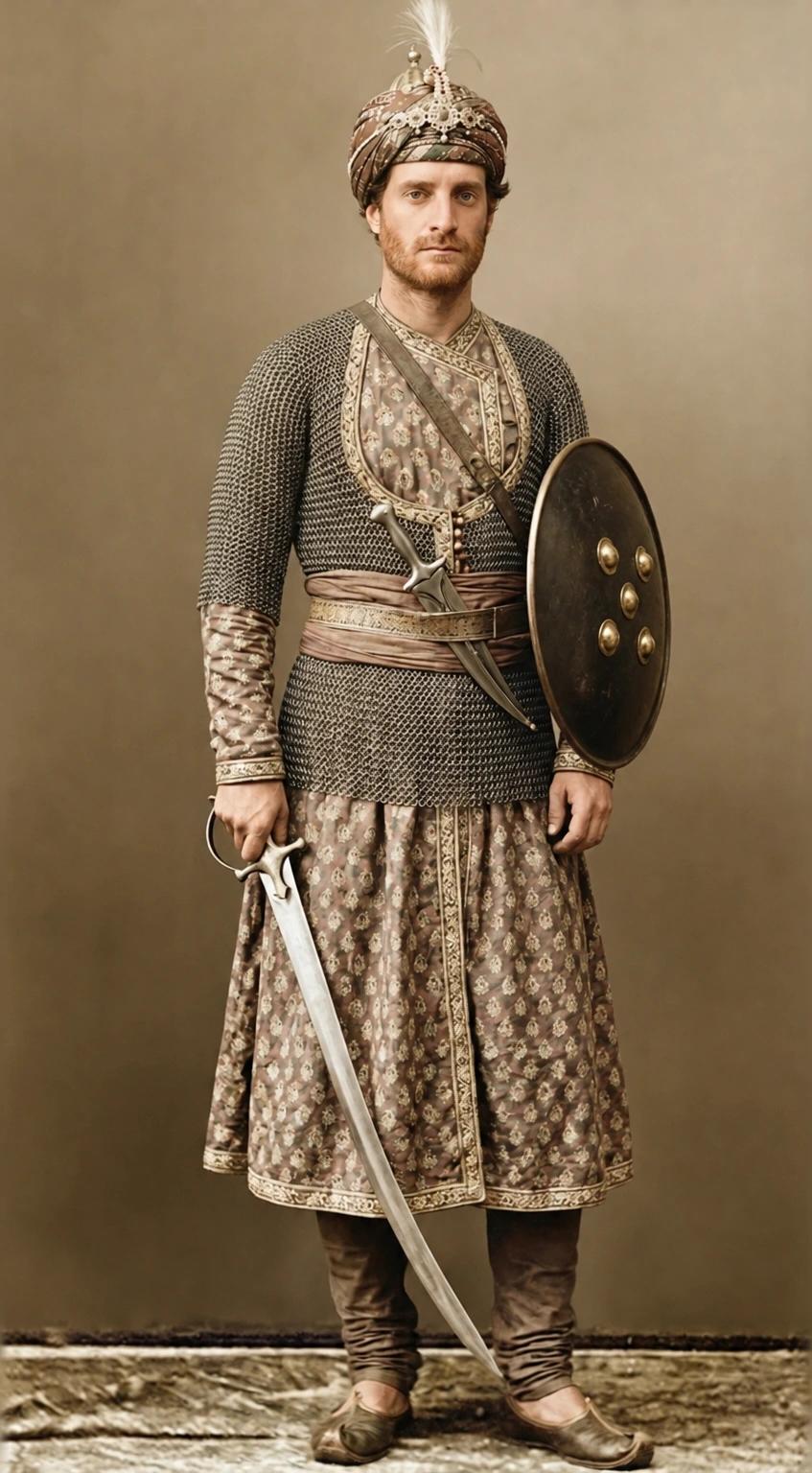
Uniform and equipment
| Uniform | Saffron robes, chainmail, turban |
|---|---|
| Dress uniform | Richly adorned turbans, jeweled weapons |
| Headgear | Turban |
| Equipment | Talwar (curved sword), katar (punch dagger), shield |
| Insignia and standard | Sun (Surya) on crimson field |
Service record
| First appeared | 6th Century |
|---|---|
| Peak strength | Clan Armies |
| Recruited from | Kshatriya Caste |
| Primary tactic | Honor Charge |
| Signature engagement | Battle of Haldighati (1576) |
| Motto or battle cry | Jai Mata Di! (Hail Mother Goddess!) |
| Obsolescence | British Conquest |
Timeline
- 700: Rise of the Clans. Emergence of the Rajput warrior caste (Kshatriyas) in Northern India following the collapse of the Gupta Empire.
- 1192: Fall of Delhi. Defeat at the Second Battle of Tarain marks the beginning of Islamic rule in North India and the retreat of Rajputs to the desert strongholds.
- 1303: First Jauhar of Chittor. Alauddin Khilji besieges Chittorgarh; Queen Padmini leads the mass self-immolation of women while men ride out to die.
- 1527: Artillery Era Begins. Battle of Khanwa exposes the vulnerability of traditional Rajput cavalry charges against modern gunpowder artillery.
- 1576: Legend of Haldighati. Maharana Pratap confronts Akbar's forces, cementing the Rajput ethos of 'death before dishonor'.
- 1818: British Treaties. Most Rajput states sign subsidiary alliances with the British East India Company, ending centuries of constant warfare.
Battles
First Battle of Tarain
Prithviraj Chauhan's cavalry overwhelmed the Ghurid flanks. The Rajput charge broke the enemy lines, forcing Muhammad Ghori to flee, showcasing the effectiveness of traditional Rajput shock tactics.
Battle of Khanwa
The turning point of medieval Indian history. Rajput valor clashed with Mughal artillery. Despite Sanga's ferocity, the traditional charge was broken by Babur's cannons and matchlocks, establishing Mughal dominance.
Battle of Haldighati
In a narrow pass of yellow clay, Pratap's forces launched a suicidal frontal charge against the Mughal army. Though technically a Mughal victory, Pratap escaped to continue the war, making it a moral triumph of resistance.
Commanders
Maharana Pratap
The Lion of Mewar who refused to bow to the Mughal Empire. Trading his palace for the rugged Aravalli hills, he waged a relentless guerrilla war, becoming the eternal symbol of Rajput resistance and independence.
Prithviraj Chauhan
The last Hindu emperor of Delhi, celebrated for his martial prowess and chivalry. He famously defeated Muhammad Ghori at the First Battle of Tarain, embodying the zenith of Rajput power before the Ghurid conquest.
Rana Sanga
A warrior-king who united the Rajput clans. Despite losing an arm, an eye, and a leg in combat, and bearing over eighty scars, he led a massive coalition against Babur to decide the fate of Northern India.
Tactics
Saka (The Last Stand)
When defeat was inevitable, warriors donned saffron robes and rode out to die killing as many enemies as possible, while women committed Jauhar (self-immolation).
Shock Cavalry Charge
A high-speed frontal assault aimed at breaking enemy lines through sheer momentum and the psychological impact of fearlessness.
Ganim Kava
A form of guerrilla warfare adopted by Maharana Pratap, utilizing the Aravalli terrain to ambush heavy Mughal columns.