
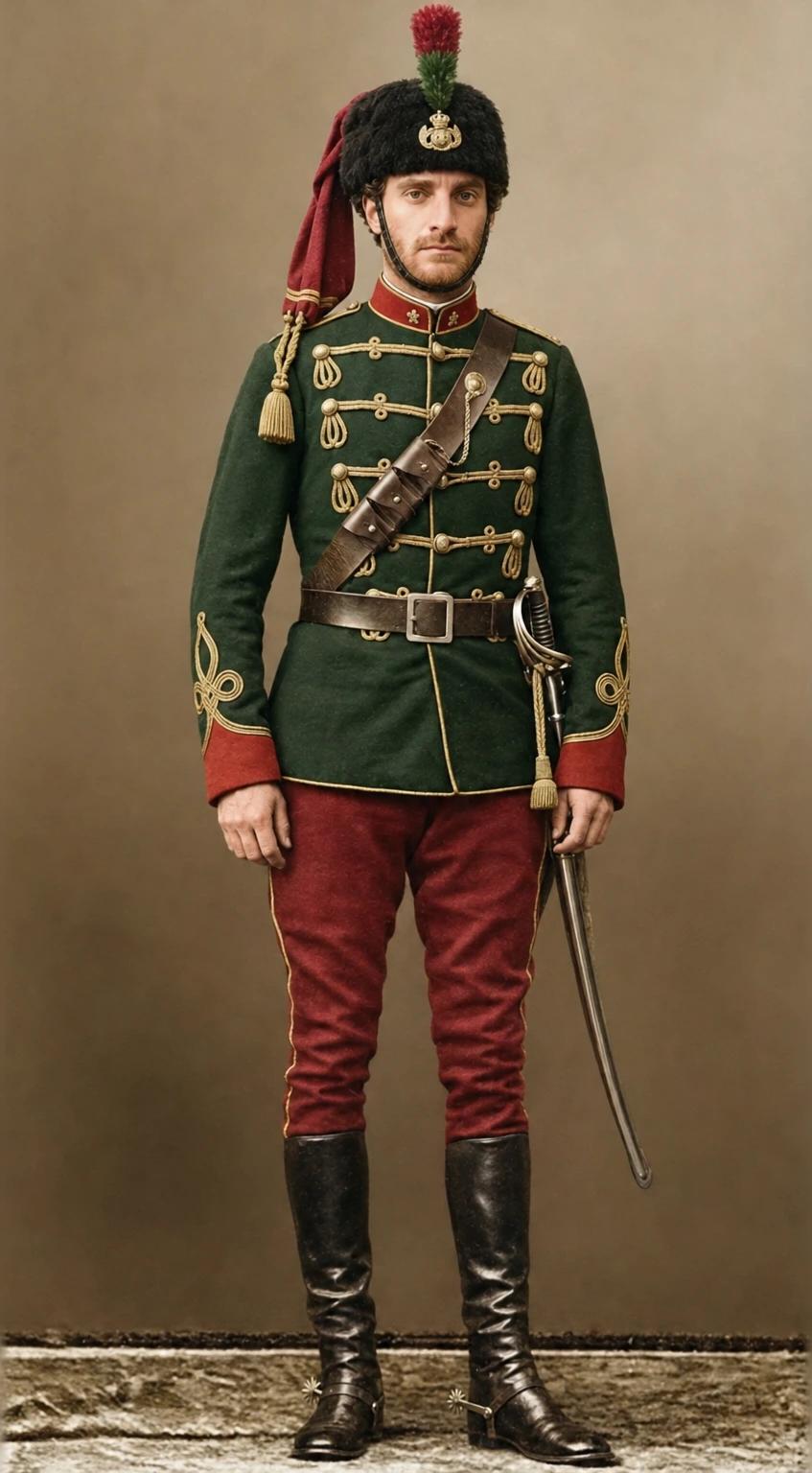
Uniform and equipment
| Uniform | Green tunic, crimson facings, yellow piping |
|---|---|
| Dress uniform | Dark green with heavy gold lace, crimson sash, medals |
| Headgear | Fur busby with red over green plume |
| Equipment | Sabre, carbine |
| Insignia and standard | Crowned royal monogram or Belgian lion on sabretache/helmet |
Service record
| First appeared | 1833 |
|---|---|
| Peak strength | ~1,000 riders |
| Recruited from | Wealthy Volunteers |
| Primary tactic | Reconnaissance / Charge |
| Signature engagement | Battle of Haelen (1914) |
| Motto or battle cry | Comitante Honore (With Honour Accompanying) |
| Obsolescence | Mechanization |
Timeline
- 1833: Formation. Established as the 'Guides to the Field Marshal', later becoming the Royal Guard.
- 1870: Mobilization. Deployed to the borders to guard Belgian neutrality during the Franco-Prussian War.
- 1914: The Silver Helmets. Achieved immortal fame at the Battle of Haelen, repelling the German Cavalry Corps.
- 1918: The Last Charge. Executed the Charge of Burkel, aiding the final liberation of Belgium.
- 1937: Motorization. Transition began from horses to armored vehicles and light tanks (T-13s).
- 1994: Amalgamation. Merged with other units, eventually forming the Guides Battalion within the modern Belgian Land Component.
Battles
Battle of Haelen
Known as the 'Battle of the Silver Helmets.' The Guides, fighting alongside Lancers, dismounted to repel a massive German cavalry assault. Their disciplined carbine fire shattered the myth of German invincibility and halted the advance.
Charge of Burkel
In the dying days of WWI, the Guides launched a desperate, heroic charge against entrenched German infantry. Despite heavy casualties, they overran the enemy positions, seizing the strategic hamlet and forcing a surrender.
Battle of the Lys
Now motorized, the Guides fought a gritty delaying action against the overwhelming German Blitzkrieg. They held their ground to allow the main army to retreat, suffering severe losses before the eventual capitulation.
Commanders
King Leopold I
The first King of the Belgians and the regiment's founder. He modeled the Guides on the French Imperial Guard, forging them into a premier royal escort and an elite fighting force that served as the backbone of the young nation's cavalry.
Lieutenant-General Léon de Witte de Haelen
A tactical pragmatist who commanded the Cavalry Division at Haelen. Breaking with tradition, he ordered his elite troopers to dismount and utilize carbine fire, decimating the German Uhlans in a defensive masterclass.
Major General Victor van Strydonck de Burkel
A fearless commander who led the legendary Charge of Burkel in 1918. Under withering machine-gun fire, he rallied the Guides for one of the Great War's last successful cavalry charges to cut off a German retreat.
Tactics
Reconnaissance in Force
Acting as the 'eyes' of the army, pushing ahead to locate enemy dispositions and screen the main force.
Dismounted Skirmishing
Utilizing carbines from cover when the terrain or enemy fire prevented mounted action, a tactic that saved the line at Haelen.
Shock Charge
A coordinated gallop with drawn sabres or leveled lances to break enemy formations physically and psychologically.