
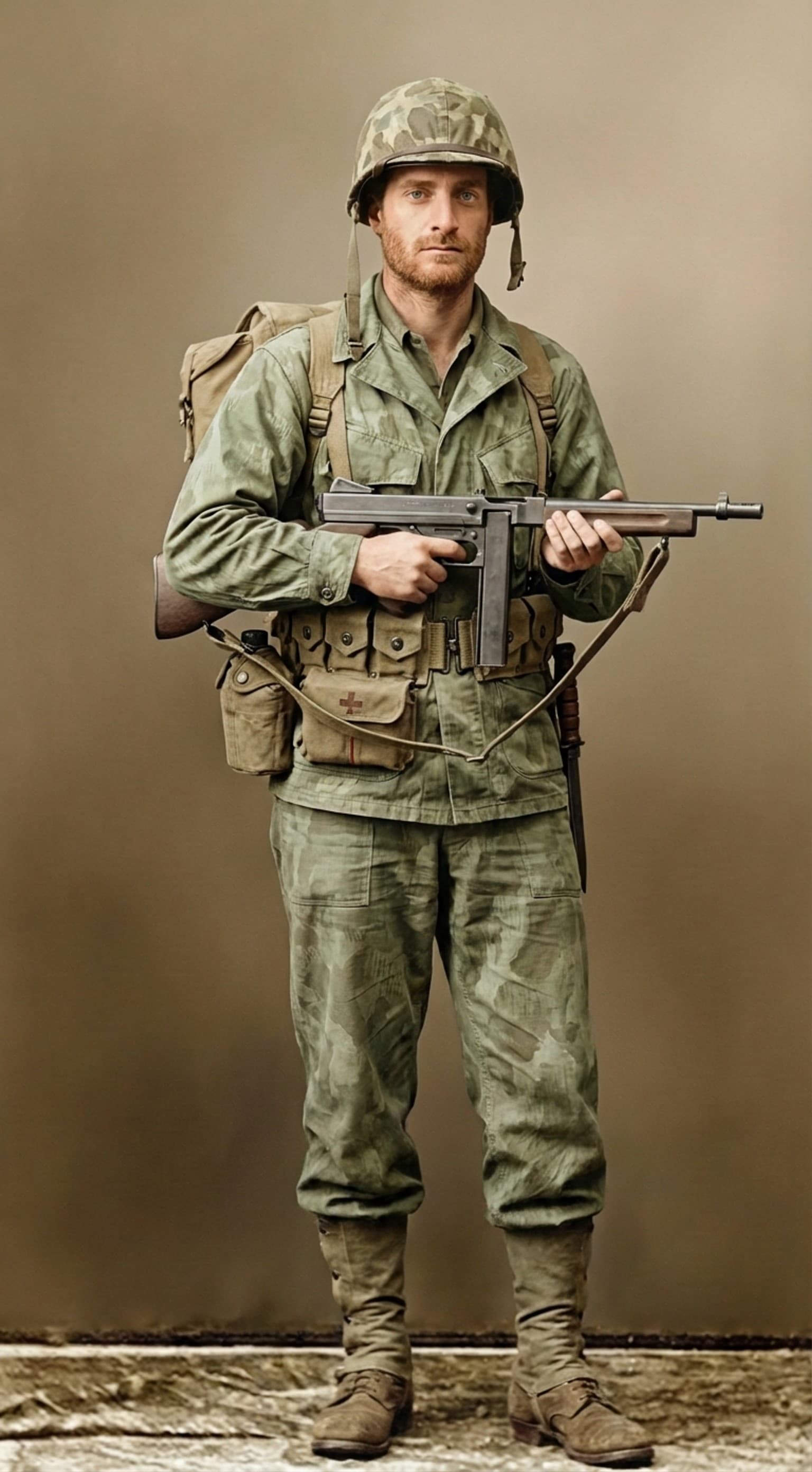
Uniform and equipment
| Uniform | USMC Utilities (Dungarees), Frogskin camo |
|---|---|
| Dress uniform | USMC Dress Blues |
| Headgear | M1 Helmet with camo cover |
| Equipment | M1 Carbine, Reising SMG, Ka-Bar knife |
| Insignia and standard | Skull and Southern Cross diamond patch |
Service record
| First appeared | 1942 |
|---|---|
| Peak strength | 4 Battalions |
| Recruited from | Selected Marines |
| Primary tactic | Rubber Boat Raid |
| Signature engagement | Makin Island Raid (1942) |
| Motto or battle cry | Gung Ho! (Work Together) |
| Obsolescence | Merged into 4th Marines |
Timeline
- 1942: Activation. The 1st and 2nd Marine Raider Battalions are activated in February to conduct amphibious raids and guerrilla warfare.
- 1942: The Makin Raid. Carlson's Raiders conduct the first American offensive operation against Japanese-held territory via submarine insertion.
- 1942: Defense of Guadalcanal. Raiders play a pivotal role in holding the perimeter around Henderson Field during the critical early months of the campaign.
- 1943: Consolidation. The 1st Marine Raider Regiment is formed, combining the four Raider battalions for larger-scale operations in the Central Solomons.
- 1943: Bougainville Campaign. Raiders lead the assault on Bougainville, fighting through swamp and jungle to secure beachheads.
- 1944: Disbandment. Deemed redundant as the nature of the war shifted to massive amphibious assaults, the Raiders were disbanded and redesignated as the 4th Marine Regiment.
Battles
Makin Island Raid
Launched from submarines USS Nautilus and USS Argonaut, the Raiders executed a high-risk amphibious assault to destroy Japanese installations. Though the extraction was chaotic, it was a massive morale boost for a nation reeling from Pearl Harbor.
Battle of Edson's Ridge
The 1st Raider Battalion, exhausted and outnumbered, held a grassy ridge protecting Henderson Field against the Kawaguchi Detachment. In a brutal close-quarters night battle, they broke the back of the Japanese offensive, securing the air strip.
Raid on Tasimboko
Acting on intelligence from native scouts, Edson's Raiders struck a Japanese rear echelon supply depot. They destroyed stockpiles of food and ammunition and captured critical intelligence documents before withdrawing, crippling enemy logistics.
Battle of Bairoko Harbor
Raiders assaulted heavily fortified Japanese bunkers in the jungle. Lacking heavy fire support, they suffered high casualties but displayed immense bravery. The engagement highlighted the limitations of light infantry against entrenched positions.
Commanders
Lt. Col. Evans Carlson
A maverick visionary who adopted Chinese guerrilla tactics and the philosophy of 'Gung Ho' (work together). He led the 2nd Raider Battalion during the daring Makin Island raid, instilling a spirit of egalitarian brotherhood that defined the unit's unique culture.
Col. Merritt 'Red Mike' Edson
Commander of the 1st Raider Battalion, Edson was the steel-jawed professional to Carlson's idealist. He earned the Medal of Honor for his legendary defense of 'Edson's Ridge' on Guadalcanal, where his men held the line against overwhelming Japanese assaults.
Maj. James Roosevelt
The eldest son of President FDR and XO of the 2nd Raiders. Far from a political figurehead, he served with distinction in the Pacific, providing critical leadership during the chaotic withdrawal from Makin Island despite suffering from severe health issues.
Tactics
Submarine Insertion
Raiders utilized fleet submarines to approach enemy coastlines undetected, launching rubber boats (LCR-Ls) to paddle ashore under the cover of darkness for surprise attacks.
Fire Team Formation
Carlson introduced the 3-man 'fire team' concept (rifleman, BAR gunner, submachine gunner) to the USMC, decentralizing command and increasing flexibility in jungle combat.
Gung Ho Philosophy
More than a slogan, this involved 'ethical indoctrination' where every man, regardless of rank, could discuss battle plans, fostering unmatched initiative and unit cohesion.
Jungle Patrolling
Aggressive, long-range patrols behind enemy lines to gather intelligence, ambush supply columns, and disrupt Japanese communications.