
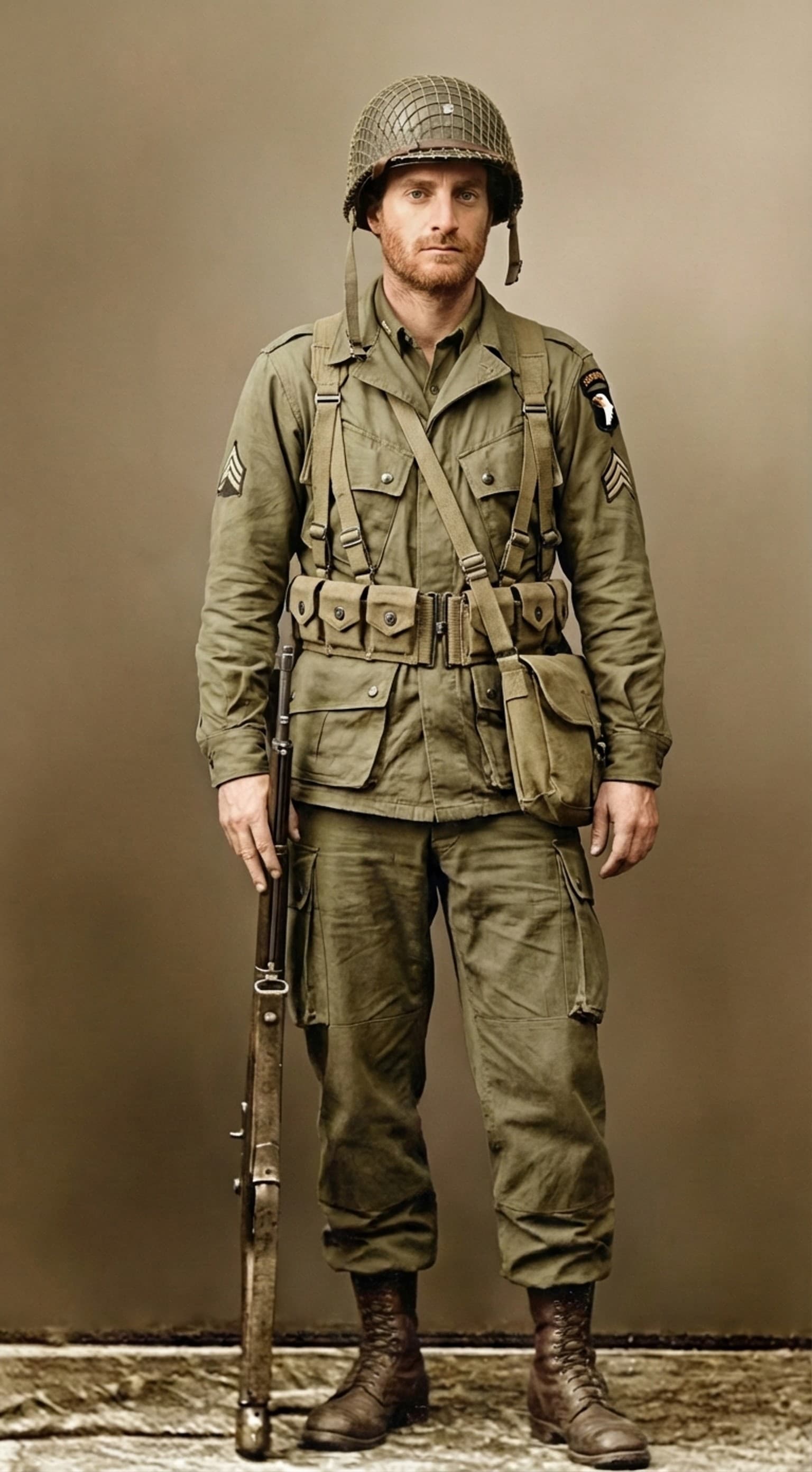
Uniform and equipment
| Uniform | M42 Jump uniform (reinforced pockets) |
|---|---|
| Dress uniform | Class A with Screaming Eagle patch |
| Headgear | M1 Helmet with Spade/Heart/Club/Diamond stencil |
| Equipment | M1 Garand, M1A1 Carbine, Leg bag |
| Insignia and standard | Old Abe eagle patch on black shield with AIRBORNE tab |
Service record
| First appeared | 1942 |
|---|---|
| Peak strength | Division |
| Recruited from | Volunteers |
| Primary tactic | Vertical Envelopment |
| Signature engagement | Siege of Bastogne (1944) |
| Motto or battle cry | Rendezvous With Destiny |
| Obsolescence | Helicopter Air Assault (Evolution) |
Timeline
- 1942: Activation. The 101st Division is activated at Camp Claiborne, Louisiana, with Major General William C. Lee promising the unit has a 'rendezvous with destiny.'
- 1944: Normandy Drop. The division conducts its first combat jump into France, securing exits for the amphibious forces at Utah Beach.
- 1944: The Bulge. Rushed to the front in open trucks, the division establishes a perimeter at Bastogne, holding out against the German winter offensive.
- 1945: Capture of the Eagle's Nest. Elements of the 101st seize Hitler's mountain retreat in Berchtesgaden, drinking the Führer's cognac to celebrate the end of the war in Europe.
- 1945: Deactivation. Following the surrender of Japan, the division is deactivated in France, ending its World War II chapter.
- 1968: Airmobile Transformation. The division is redesignated as 'Air Cavalry' for Vietnam, trading parachutes for helicopters, marking the evolution from Airborne to Air Assault.
Battles
Operation Overlord (D-Day)
Dropped behind Utah Beach in chaotic darkness, the Eagles secured vital causeways amidst flooded fields. Despite scattered sticks and heavy losses, they improvised fiercely, neutralizing German artillery and preventing the beachhead from being overrun.
Operation Market Garden
Tasked with capturing bridges to pave the way into Germany, the 101st liberated Eindhoven and held 'Hell's Highway' open against constant counterattacks. While the operation ultimately stalled, the division achieved its specific tactical objectives with grit.
Siege of Bastogne
Encricled, outgunned, and lacking winter gear in freezing fog, the 101st held the critical road junction against superior German armor. Their stubborn defense broke the momentum of the entire German offensive in the Ardennes.
Commanders
Major Richard Winters
An officer of Easy Company whose tactical brilliance at Brécourt Manor is still taught today. Winters personified the citizen-soldier ideal, leading with quiet stoicism and earning the undying loyalty of the 'Band of Brothers' from Toccoa to the Eagle's Nest.
Major General Maxwell D. Taylor
A scholar-soldier and master tactician who jumped into Normandy with his men. Taylor transformed the 101st into a disciplined elite force, leading them through the hedgerows of France and the doomed bridges of Market Garden with intellectual rigor and frontline courage.
Brigadier General Anthony McAuliffe
The defiant acting commander during the Siege of Bastogne. When surrounded by German armor demanding surrender, his one-word reply—"Nuts!"—became legendary, embodying the division's refusal to break under the crushing pressure of the Ardennes winter.
Tactics
Vertical Envelopment
Dropping massed infantry behind enemy fortifications to sever supply lines, disrupt communications, and attack defenses from the rear.
Hedgehog Defense
A perimeter tactic used at Bastogne where the unit forms a tight, all-around defensive circle, allowing them to hold ground while completely surrounded.
Pathfinder Operations
Sending small, specialized teams ahead of the main force to mark drop zones with radar beacons and lights to minimize dispersion.
Stick Dispersal
Small unit autonomy born of necessity; when drops were scattered, paratroopers formed ad-hoc 'LGOPs' (Little Groups of Paratroopers) to harass the enemy aggressively.