
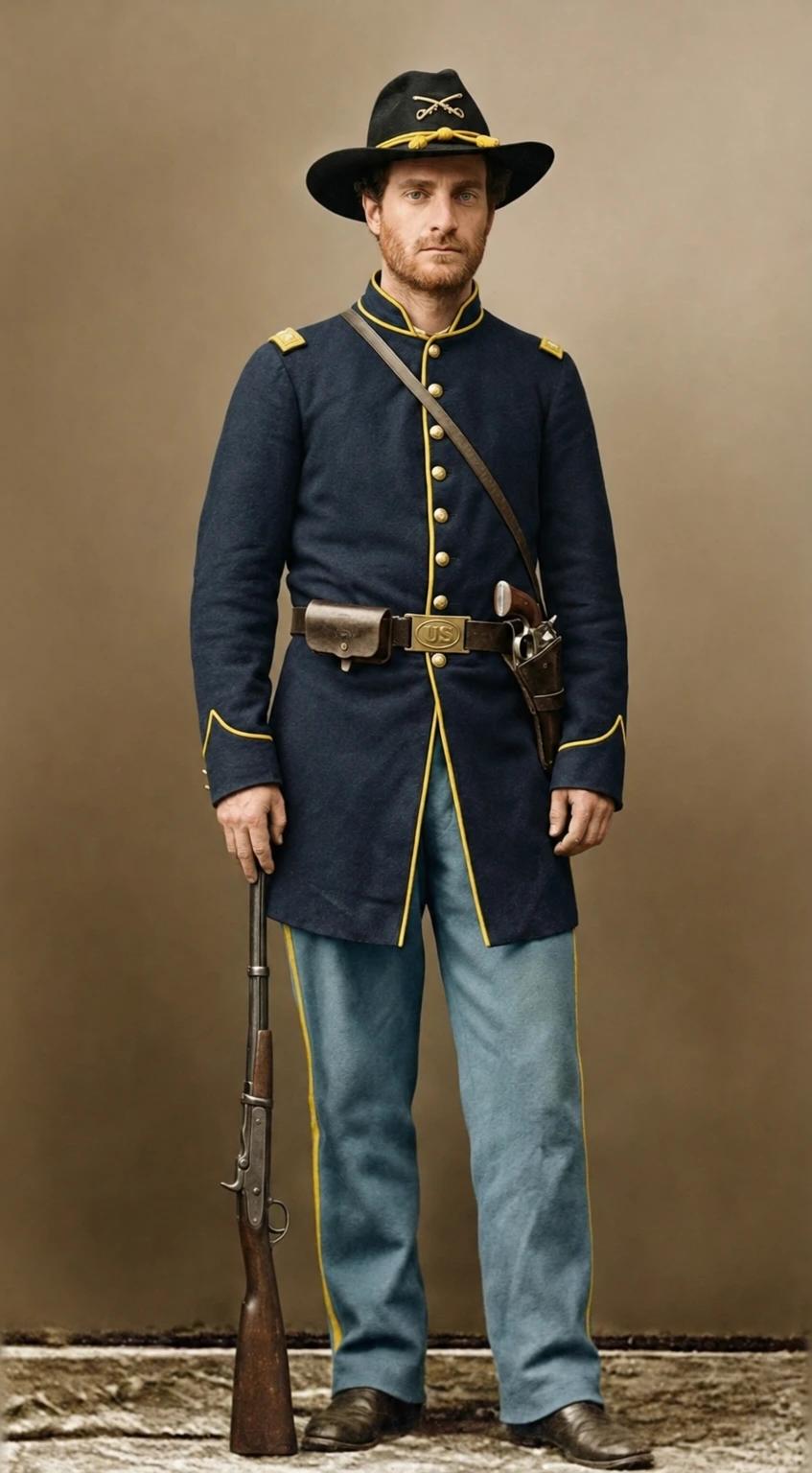
Uniform and equipment
| Uniform | Dark blue fatigue blouse, sky-blue trousers with yellow stripe |
|---|---|
| Dress uniform | Full dark blue tunic with yellow facings, white gloves, parade belts |
| Headgear | Black felt campaign hat or forage cap with yellow cords |
| Equipment | Carbine, revolver, cavalry sabre (earlier period) |
| Insignia and standard | Crossed sabers with '7' |
Service record
| First appeared | 1866 |
|---|---|
| Peak strength | ~1,200 troopers |
| Recruited from | Volunteers (Immigrants/Civil War Vets) |
| Primary tactic | Dismounted Skirmish / Charge |
| Signature engagement | Battle of the Little Bighorn (1876) |
| Motto or battle cry | Garry Owen (Regimental tune) |
| Obsolescence | End of Frontier |
Timeline
- 1866: Regiment Constituted. The 7th Cavalry is organized at Fort Riley, Kansas, specifically to protect settlers and secure the Western frontier.
- 1868: Washita Campaign. First major engagement under Custer, establishing the unit's aggressive ethos against the Southern Plains tribes.
- 1873: Yellowstone Expedition. Escort duty for the Northern Pacific Railroad, resulting in several sharp skirmishes with Sitting Bull's Lakota.
- 1874: Black Hills Expedition. Custer leads the regiment into the sacred Black Hills, confirming gold deposits and triggering the Great Sioux War.
- 1876: Disaster at Little Bighorn. Loss of the regimental commander and five full companies; the regiment is subsequently rebuilt and continues campaigning.
- 1877: Nez Perce War. The rebuilt regiment pursues Chief Joseph's band across Montana, engaging them at Canyon Creek and Bear Paw.
- 1890: End of the Frontier. Operations at Wounded Knee mark the effective end of the regiment's role as a frontier constabulary force.
Battles
Battle of the Washita
A dawn raid on Black Kettle's Cheyenne village in deep snow. Custer utilized a four-column convergence to surprise the camp, securing a controversial victory that established the regiment's reputation for relentless winter campaigning.
Battle of the Little Bighorn
The regiment's defining tragedy. Seeking to encircle a massive coalition of Lakota and Cheyenne, Custer's five companies were isolated and annihilated. It remains the archetype of the 'Last Stand' and the most analyzed defeat in American history.
Battle of Wounded Knee
The tragic closing chapter of the Indian Wars. An attempt to disarm a Lakota band turned into a chaotic firefight and massacre in freezing conditions, effectively ending armed Native American resistance on the Plains.
Commanders
George Armstrong Custer
The flamboyant 'Boy General' of the Civil War turned Indian fighter. Known for his aggression, distinctive long hair, and buckskins, he led the 7th with a mix of dashing charisma and reckless ambition until his legendary demise.
Marcus Reno
Custer's senior subordinate whose defensive action at the Little Bighorn saved the remnant of the regiment. Often maligned for failing to support Custer, he held the bluffs against overwhelming odds in a desperate two-day siege.
Tactics
Dismounted Skirmish Line
Troopers dismounted, with every fourth man holding horses, forming a firing line to utilize the range and accuracy of their carbines.
Converging Columns
An operational strategy of splitting forces to attack a village from multiple directions simultaneously to prevent escape.
Winter Campaigning
Conducting offensives during harsh winter months to strike immobile villages when Indian ponies were weak and forage was scarce.