
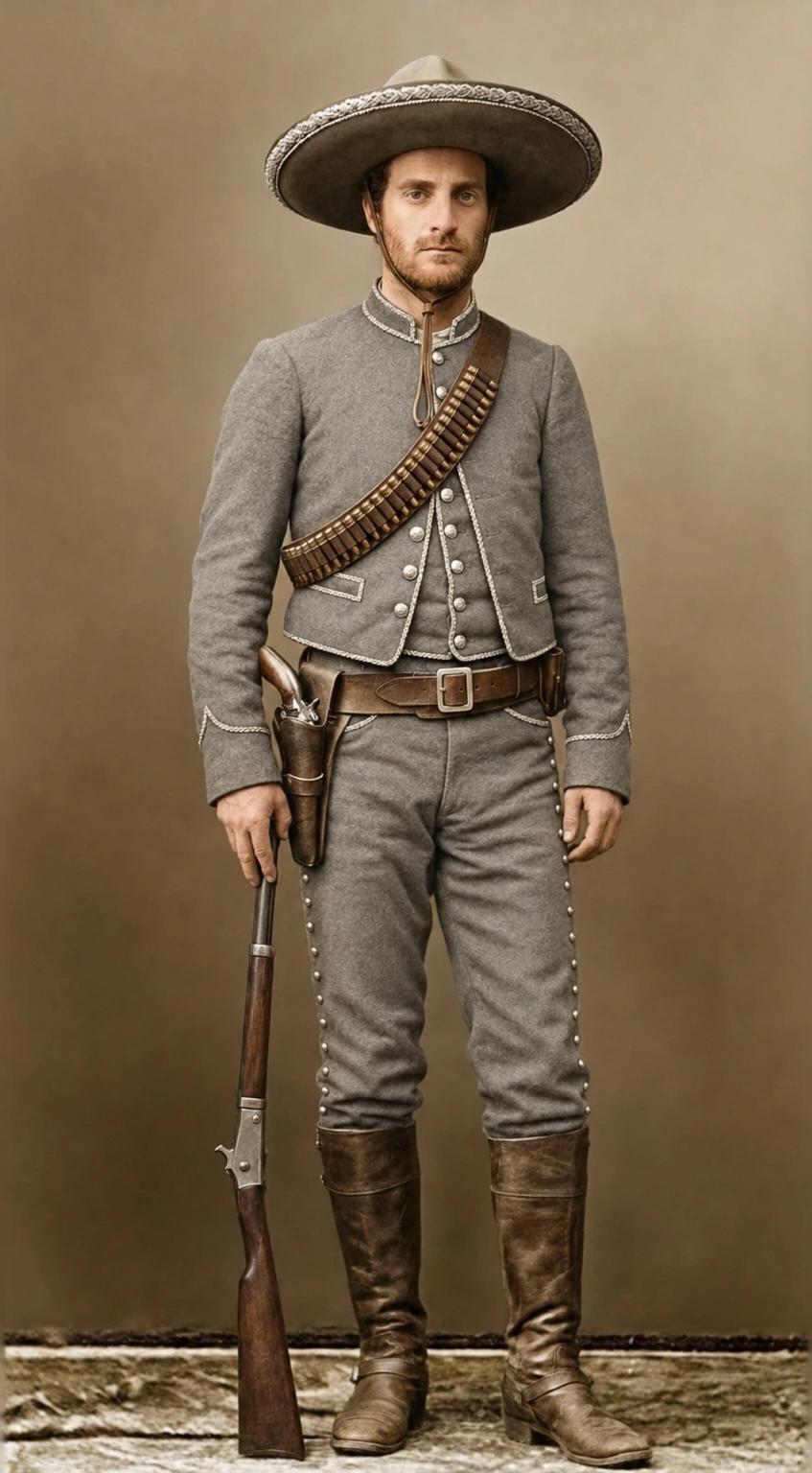
Uniform and equipment
| Uniform | Charro-style gray or brown suit with silver buttons, leather chaparreras |
|---|---|
| Dress uniform | Elaborate charro suits with extensive silver trim, colored sashes |
| Headgear | Wide-brimmed sombrero with silver band |
| Equipment | Carbine, revolvers, machete |
| Insignia and standard | Silver Mexican eagle on charro sombrero |
Service record
| First appeared | 1861 |
|---|---|
| Peak strength | 4,000–5,000 men |
| Recruited from | Former Bandits / Rural Police |
| Primary tactic | Mounted Police Action |
| Signature engagement | Cananea Strike (1906) |
| Motto or battle cry | Orden y Progreso (Order and Progress) |
| Obsolescence | Mexican Revolution (1910) |
Timeline
- 1861: Formation. President Benito Juárez establishes the 'Cuerpo de Policía Rural' to secure highways against banditry.
- 1876: Expansion under Díaz. Porfirio Díaz expands the corps, placing them under federal control to centralize power and enforce order.
- 1892: Tomochic Massacre. Participation in the bloody suppression of the Tomochic rebellion, cementing their reputation for ruthlessness.
- 1906: Cananea Incident. Deployment to break the copper miners' strike, acting as enforcers for foreign capital.
- 1914: Disbandment. Following the fall of the Huerta regime, the Rurales are formally disbanded and absorbed into various revolutionary factions.
Battles
Tomochic Rebellion
Rurales and Federal troops besieged the village of Tomochic to suppress a religious uprising. While the government forces eventually annihilated the defenders, the Rurales suffered heavy casualties and the massacre stained their reputation, fueling revolutionary sentiment.
Cananea Strike Suppression
The Rurales were deployed to ruthlessly crush a miners' strike at the American-owned Cananea Consolidated Copper Company. Their brutal efficiency in quelling the labor unrest demonstrated their role as the iron fist of the Díaz regime against dissent.
Battle of Ciudad Juárez
Defending the border city against Madero's revolutionaries, the Rurales fought fiercely but were ultimately overwhelmed. This defeat marked the beginning of the end for the Porfiriato and signaled the obsolescence of the Rurales' traditional tactics against massed revolutionary fervor.
Commanders
Emilio Kosterlitzky
Known as the 'Eagle of Sonora', this Russian-born deserter became the most feared Rurales commander. A master of discipline and desert warfare, he ruthlessly policed the northern frontier, turning the Rurales into an elite, if brutal, paramilitary force loyal to the Porfiriato.
Benito Juárez
While not a field commander, President Juárez established the Rurales in 1861 to combat highway banditry. His vision created the foundation of the corps, transforming bandits into policemen to secure the roads of a fractured nation.
Tactics
Ley Fuga
The 'Law of Flight'; a notorious practice where prisoners were told they could escape, only to be shot in the back, allowing for summary executions under the guise of preventing a breakout.
Force Projection
Leveraging their striking uniforms and reputation for violence to intimidate rural populations into submission without always resorting to open combat.
Desert Tracking
Utilizing expert knowledge of the terrain and local horse breeds to relentlessly pursue bandits and rebels across the arid wilderness where regular army units failed.