
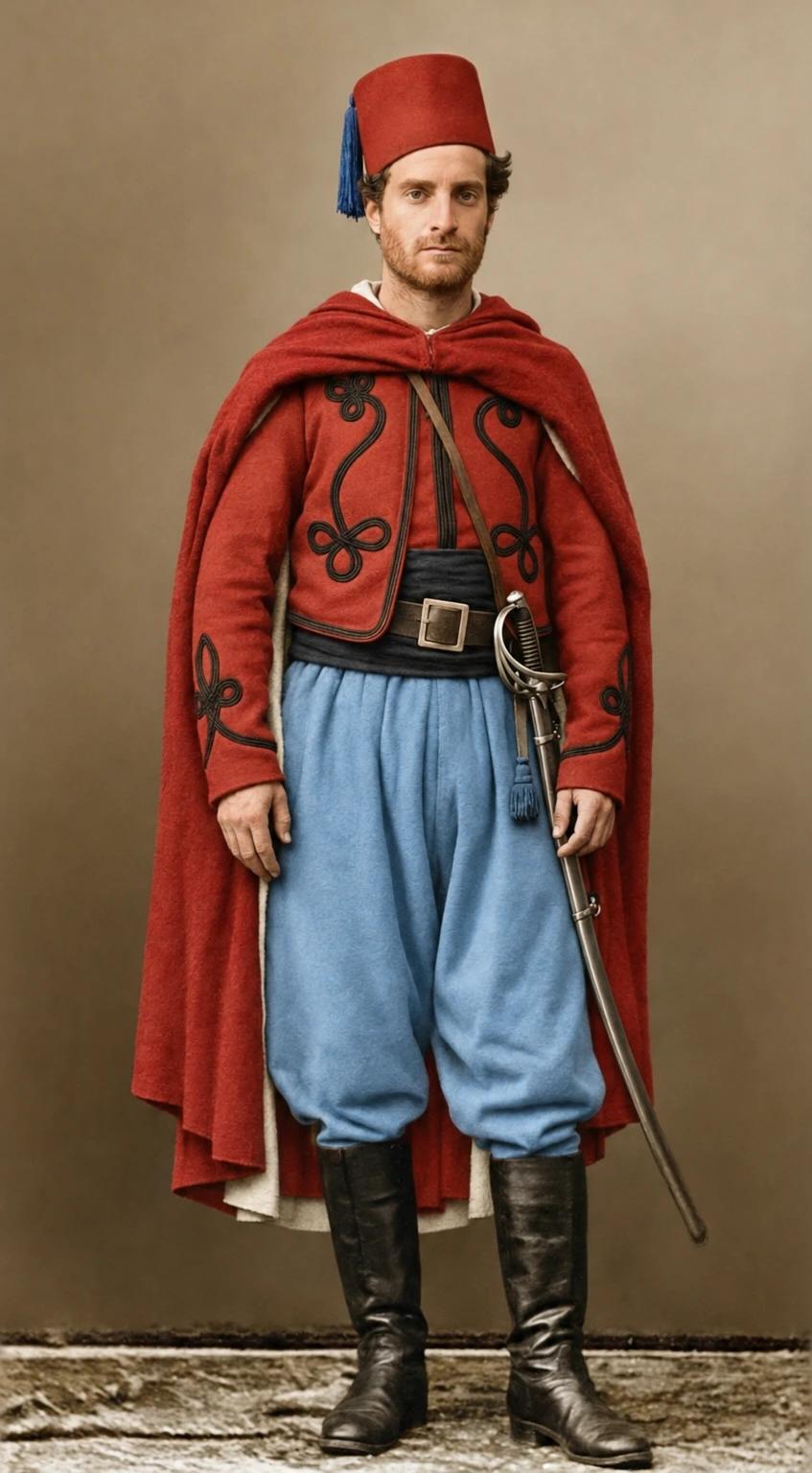
Uniform and equipment
| Uniform | Red jacket, blue baggy trousers, white burnous |
|---|---|
| Dress uniform | Full Arab-style dress with red cloak (burnous) |
| Headgear | Guennour (headdress) with cords |
| Equipment | Sabre, carbine |
| Insignia and standard | Star suspended between crescent horns |
Service record
| First appeared | 1830s |
|---|---|
| Peak strength | 4,000 men |
| Recruited from | Algerian/Moroccan Volunteers |
| Primary tactic | Light Cavalry Skirmish |
| Signature engagement | Italian Campaign (1944) |
| Motto or battle cry | Faire Face (Facing Forward / Make Front) |
| Obsolescence | Decolonization |
Timeline
- 1831: Formation. General Yusuf organizes the first irregular squadrons of native cavalry in Algiers, originally termed 'Chasseurs indigènes'.
- 1841: Regularization. The units are officially designated as 'Spahis' (from the Ottoman 'Sipahi') and integrated into the French Army structure.
- 1870: Franco-Prussian War. Spahis deploy to mainland France, seeing brutal combat and suffering from the harsh European winter.
- 1914: The Great War. Spahi regiments participate in the Race to the Sea and later serve in the Balkans and the Levant.
- 1940: The Sacrifice of 1940. Spahi brigades are decimated attempting to stop the German Blitzkrieg in the Ardennes.
- 1944: Italian Campaign. Reconstituted Spahi units spearhead the French Expeditionary Corps' mountain offensives in Italy.
- 1962: Dissolution. Following the independence of Algeria, most regiments are disbanded; the 1st Spahi Regiment remains in the modern French Army.
Battles
Capture of the Smala
A legendary Razzia. Under the Duc d'Aumale, Spahis surprised the vast tent city (Smala) of rebel leader Abd el-Kader. Despite being outnumbered, their shock charge shattered the resistance, capturing the Emir's treasury and family, effectively breaking organized resistance in Algeria.
Battle of La Horgne
The last great charge. The 3rd Spahi Brigade held the village against Guderian's 1st Panzer Division for 10 hours. With ammo spent, they charged tanks with sabres. Though wiped out, their sacrifice allowed the French 5th Division to retreat. A glorious, tragic delay.
Battle of Monte Cassino
Operating within the French Expeditionary Corps, Moroccan Spahis utilized their mountain agility to penetrate the Aurunci Mountains—terrain the Germans deemed impassable for armor—flanking the Gustav Line and breaking the stalemate on the road to Rome.
Commanders
Colonel Edmond Burnol
The embodiment of Spahi sacrifice. During the 1940 Battle of France, he commanded the 3rd Spahi Brigade at La Horgne. Facing German Panzers with nothing but light carbines and sabres, he led a suicidal defense to cover the retreat, dying alongside his men in a blaze of defiance.
General Yusuf (Joseph Vantini)
Born on Elba, enslaved by Barbary pirates, and raised in the Seraglio of Tunis, Yusuf defected to the French in 1830. A charismatic and ruthless leader, he organized the first Spahi regiments, blending indigenous riding skills with French discipline to conquer the Algerian interior.
Tactics
Razzia
A lightning-fast raid adapted from tribal warfare. Spahis would strike deep into enemy territory to seize livestock, destroy supplies, and vanish before a counter-attack could form.
Shock Charge
Drawing on the aggressive spirit of North African horsemen, Spahis utilized close-order saber charges to break infantry formations, a tactic they employed as late as 1940.
Voltige
Expert horsemanship allowing troopers to fire from the saddle at a gallop or hang from the side of the horse to use the animal's body as a shield against enemy fire.