
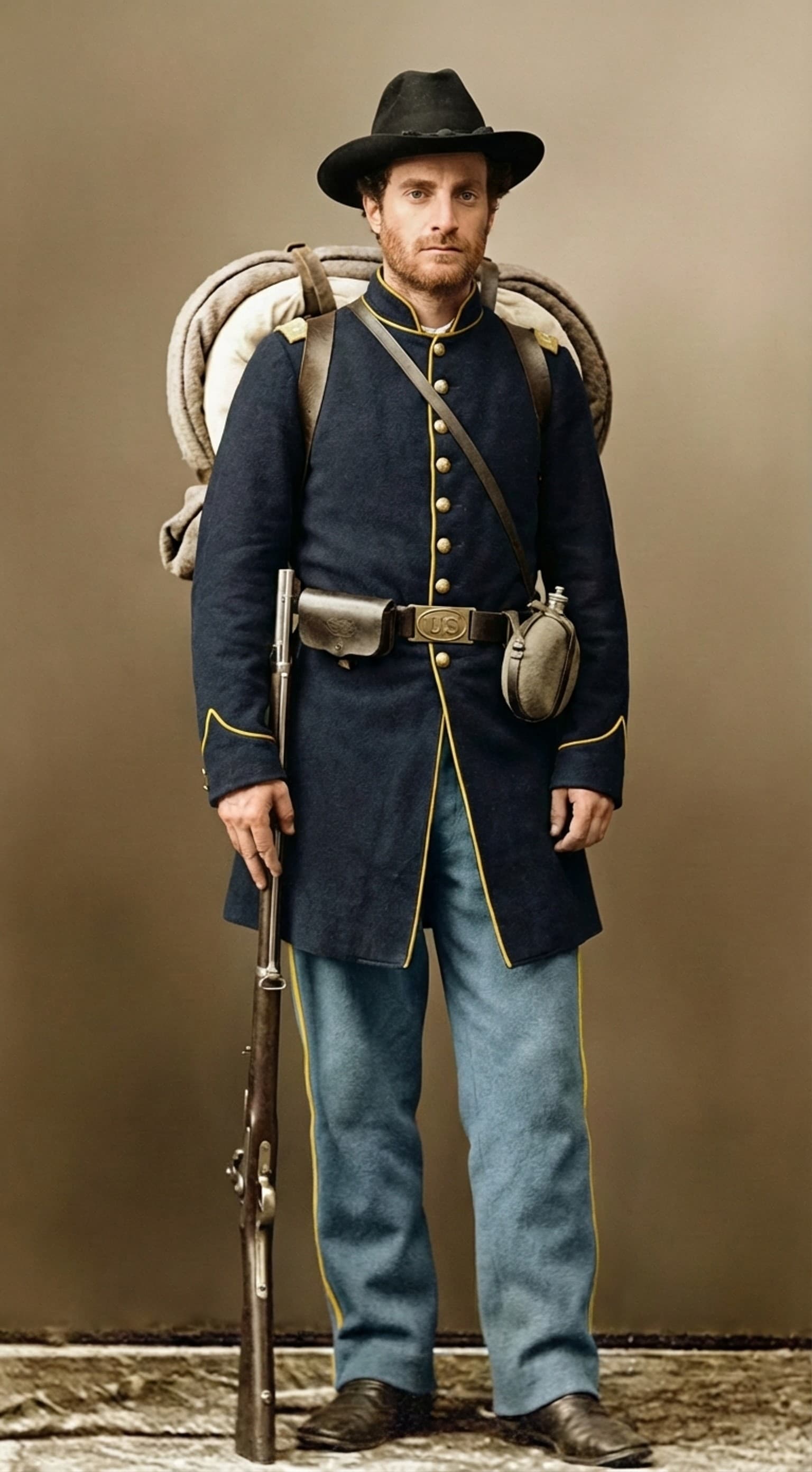
Uniform and equipment
| Uniform | Dark blue tunic, sky blue trousers |
|---|---|
| Dress uniform | Full blue uniform |
| Headgear | Campaign hat or kepi |
| Equipment | Carbine, revolver, sabre |
| Insignia and standard | Buffalo crest of 9th/10th Cavalry |
Service record
| First appeared | 1866 |
|---|---|
| Peak strength | 4 Regiments (9th/10th Cav, 24th/25th Inf) |
| Recruited from | African-American Volunteers |
| Primary tactic | Mounted Patrol / Skirmish |
| Signature engagement | Indian Wars (Apache Wars) |
| Motto or battle cry | Ready and Forward |
| Obsolescence | Integration of Army (1948) |
Timeline
- 1866: Army Reorganization Act. Congress authorizes the creation of six all-black regiments, later consolidated into the 9th and 10th Cavalry and 24th and 25th Infantry.
- 1867: Deployment to the Frontier. The regiments are sent to the Great Plains and Texas to protect settlers, guard mail routes, and build infrastructure.
- 1880: Defeat of Victorio. The 10th Cavalry plays a pivotal role in ending the Apache threat in West Texas through relentless pursuit.
- 1898: Spanish-American War. Buffalo Soldiers deploy to Cuba, earning five Medals of Honor for heroism at Las Guasimas, El Caney, and San Juan Hill.
- 1903: Park Rangers. Units are assigned to patrol Yosemite and Sequoia National Parks, becoming some of the first federal park rangers.
- 1916: Punitive Expedition. The 10th Cavalry rides into Mexico under Pershing to hunt Pancho Villa, engaging in the Battle of Carrizal.
- 1944: Deactivation. The 9th and 10th Cavalry regiments are deactivated and reorganized, marking the end of the historic horse cavalry era.
Battles
Battle of Saline River
Captain Armes and Company F of the 10th held off hundreds of Cheyenne warriors for hours. Despite being surrounded and outnumbered, the troopers maintained a disciplined defensive perimeter, proving the combat effectiveness of the newly formed black regiments.
Battle of Rattlesnake Springs
Grierson's 10th Cavalry outmarched the elusive Apache chief Victorio, seizing the only water source in the region. In a gritty standoff, they denied the Apaches hydration and forced them into Mexico, effectively breaking Victorio's campaign in Texas.
Battle of San Juan Hill
In the sweltering heat, the 9th and 10th Cavalry charged uphill alongside the Rough Riders into withering Spanish Mauser fire. Their discipline saved the flank and secured the heights, cementing their legend beyond the frontier.
Commanders
Lt. Henry O. Flipper
The first African American West Point graduate. Despite facing systemic racism, he served with distinction in the 10th Cavalry during the Victorio campaign, proving his tactical acumen and engineering skills on the harsh frontier before being unjustly dismissed.
General John J. Pershing
Before commanding the AEF in WWI, he led the 10th Cavalry in Cuba. His nickname 'Black Jack' was born from his time with these iron-willed troopers, whom he led up San Juan Hill with unwavering respect and shared danger.
Colonel Benjamin Grierson
A former music teacher who refused to tolerate prejudice, Grierson forged the 10th Cavalry into a disciplined machine. He led his men through the hellish heat of the Southwest, earning their loyalty and relentlessly pursuing the Apache leader Victorio to his doom.
Tactics
Dismounted Skirmish
Troopers would dismount to fight on foot using carbines for accuracy, with every fourth man remaining behind to hold the horses.
Endurance Tracking
Utilizing superior discipline to outlast mobile indigenous forces, tracking them for hundreds of miles across waterless terrain to force surrender.
Converging Columns
Coordinating with other units to pin down guerrilla forces, using the telegraph and heliograph to close the net on elusive raiders.