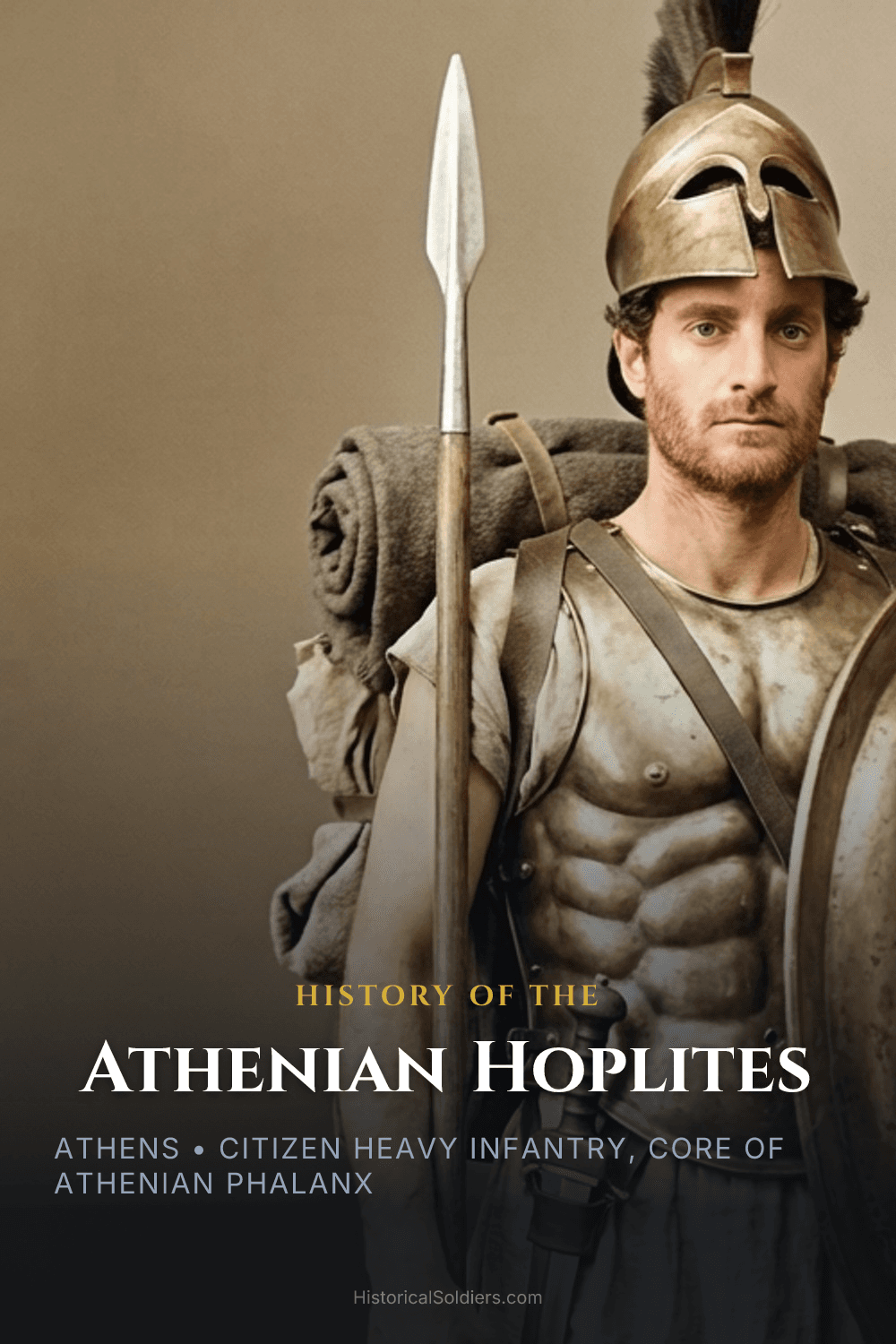
The Bronze Wall of Democracy: The Athenian Hoplites
In the shimmering heat of the Mediterranean summer, the sound of Greek warfare was not the roar of engines or the crack of gunpowder, but a terrifying, rhythmic clatter: the collision of bronze against bronze, the snapping of ash wood, and the guttural war cries of thousands of men moving as one. This was the era of the hoplite, the heavy infantryman who dominated the battlefields of the ancient world for centuries. While the Spartan Hoplites are often fetishized for their lifelong martial austerity, it was the Athenian hoplite who represented a unique and revolutionary paradox: the citizen-soldier, the philosopher-warrior, the man who built the Parthenon with one hand and held a spear with the other.
Emerging around 700 BC, the Athenian hoplite was not merely a military asset; he was the physical manifestation of the polis (city-state). Unlike the professional soldiers of the later Roman Legion or the conscripted masses of the Persian Empire, the Athenian hoplite fought for his own land, his own vote, and his own freedom. He purchased his own armor, trained with his neighbors, and stood shoulder-to-shoulder in the phalanx, a formation that required absolute trust in the man to one's right. To understand the Athenian hoplite is to understand the rise of Western civilization itself, forged in the crucible of the Persian and Peloponnesian Wars.
Origins & Formation: The Rise of the Zeugitai
Before the 7th century BC, Greek warfare was largely the domain of aristocrats—heroic champions riding chariots or engaging in disorganized duels, as immortalized in Homer’s Iliad. However, a shift in technology and socio-economics around 700 BC sparked what historians call the "Hoplite Revolution." As the middle class of Athens expanded—comprising farmers, craftsmen, and merchants—so too did the demand for political representation. This class, known as the Zeugitai (those who could afford a yoke of oxen), became the backbone of the Athenian military.
The formation of the hoplite corps was inextricably linked to the Solonian reforms and the eventual birth of democracy. The deal was implicit but clear: if a man could afford the heavy bronze panoply required for war, he earned the right to vote in the assembly. Military service was not a burden imposed by a tyrant; it was the price of citizenship. When the call to arms went out, the potter put down his clay, the playwright his stylus, and the farmer his plow. They gathered by tribe, organized not by military rank, but by their demes (districts).
This structure meant that an Athenian phalanx was a formation of neighbors and relatives. A man did not hold his ground simply to avoid punishment from a commander; he held his ground because the man next to him was his brother-in-law, his business partner, or the man he sat next to at the theater. This social cohesion provided the Athenian heavy infantry with a morale and resilience that often shocked their aristocratic or mercenary opponents.
Uniform & Equipment: The Panoply of War
To stand in the Athenian line was to bear a crushing physical burden. The full set of equipment, known as the panoply, weighed between 50 and 70 pounds. It was a stifling, claustrophobic enclosure of bronze and linen, designed for maximum protection in a collision of massed infantry.
The Aspis
The defining piece of equipment was the Aspis (often incorrectly called a hoplon). This was a large, circular shield, roughly three feet in diameter, made of wood and faced with a thin layer of bronze. Its revolutionary design featured a double-grip system: the porpax (a central armband) and the antilabe (a handle near the rim). This allowed the shield to be supported by the left shoulder and arm, freeing the hand to help guide the spear. Crucially, the shield was too large to protect only the bearer; it extended to the left, covering the unshielded right side of the comrade standing next to him. This interdependence was the mechanical soul of the phalanx.
The Dory and Sauroter
The primary offensive weapon was the Dory, a thrusting spear roughly seven to nine feet in length. Crafted from cornel or ash wood, it was tipped with a leaf-shaped iron spearhead. However, the genius of the design lay at the opposite end: the Sauroter, or "lizard killer." This was a heavy bronze spike used as a counterweight. If the primary spearhead snapped in the violence of the clash—a common occurrence—the hoplite could flip the spear and fight with the Sauroter. It also allowed the spear to be planted upright in the ground during rest, creating a forest of wood and iron.
Defensive Armor
Protection for the body evolved over the centuries. In the early period, and for the wealthiest citizens, the bronze "bell cuirass" was common. However, by the time of the Persian Wars, many Athenians favored the Linothorax. This was a composite armor made of layers of linen glued together, often reinforced with scales or metal plates. While it sounds flimsy compared to bronze, the Linothorax was stiff, tough, and significantly lighter and cooler—a vital consideration in the Greek summer. Below the knees, the hoplite wore Knemides (greaves), formed from flexible bronze that snapped onto the shins without straps, protecting the legs from the low thrusts of enemy spears.
The Corinthian Helmet
Perhaps the most iconic image of the hoplite is the Corinthian helmet. Made from a single sheet of bronze, it covered the entire face, leaving only slits for the eyes and mouth. It offered superb protection but came at a high cost: it severely restricted vision and hearing. Inside this helmet, a hoplite was isolated, hearing only the thrum of his own blood and the muffled chaos of battle. Later eras saw a shift to more open-faced helmets (like the Chalcidian or Thracian types) to allow for better situational awareness, but the Corinthian remains the symbol of the heavy infantry's stoic anonymity.
Secondary Gear
If the phalanx broke or the spear was lost, the hoplite drew his Xiphos, a double-edged short sword used for hacking and thrusting in close quarters. Finally, a piece of non-combat equipment essential to the soldier's life was the Strigil. After training or battle, the hoplite would cover himself in olive oil and use this curved metal tool to scrape off the mixture of sweat, dust, and blood—a ritual of cleansing that defined the Greek gymnasium culture.
Tactics & Doctrine: The Push of Pikes
The tactical doctrine of the Athenian hoplite was centered entirely on the phalanx. This was a block formation, usually eight ranks deep. The objective was not individual dueling, but the application of collective force. When two phalanxes collided, it resulted in the othismos, or "the shove." The rear ranks would press their shields into the backs of the men in front, driving the formation forward like a human steamroller.
The phalanx had a natural tendency to drift to the right during an advance. Because each man sought the protection of his neighbor's shield on his unarmored right side, the entire line would crab-walk diagonally. Commanders had to account for this drift, often placing their best troops—or the commander himself—on the extreme right flank to anchor the line. This made the right wing the position of honor and the critical point of attack.
Unlike the flexible maneuvers of the later Macedonian Phalanx or the complex checkerboard formations of the Roman Legion, Athenian tactics were relatively static. The goal was to maintain cohesion. If the line broke, the hoplites were vulnerable to cavalry and light infantry. However, as long as the "Bronze Wall" held, they were virtually impenetrable to frontal assault. The violence was short, sharp, and decisive. Once one side broke, the slaughter began, though pursuit was often limited by the weight of the armor.
Combat History: From Marathon to Sicily
The combat record of the Athenian hoplites includes some of the most pivotal battles in human history, where the fate of Western democracy hung by a thread.
The Miracle at Marathon (490 BC)
Under the command of Miltiades and the War Archon Callimachus, the Athenian hoplites faced the might of the Persian Empire on the plain of Marathon. Outnumbered roughly two to one, the Athenians did the unthinkable. To minimize the time they were exposed to Persian archery, the heavy infantry broke into a run—a terrifying feat of endurance given their 60-pound load. They smashed into the Persian line, their bronze shields shattering the wicker shields of the invaders. Miltiades had thinned his center to strengthen his wings; while the center buckled, the Athenian wings crushed the Persian flanks and enveloped them. It was a victory of heavy shock infantry over light skirmishers, proving the superiority of the hoplite panoply.
The Endurance of Plataea (479 BC)
At the Battle of Plataea, the Athenian contingent stood alongside the Spartans to deliver the final blow to Xerxes' invasion. While the Spartans handled the brunt of the fighting against the Persian Immortals, the Athenians engaged the Thebans (Greeks who had sided with Persia). The battle was a chaotic, drawn-out affair that tested the physical stamina of the hoplites. The Athenians demonstrated that they could hold their own not just against "barbarians," but against fellow Greeks trained in the same manner of war.
The Tragedy of Syracuse (415–413 BC)
The golden age of the Athenian hoplite met a grim end during the Peloponnesian War. In an ambitious attempt to expand their empire, Athens launched a massive expedition against Syracuse in Sicily. The campaign was a disaster of leadership and logistics. The Athenian hoplites, usually masters of the open field, found themselves trapped in difficult terrain, suffering from dehydration and disease. The final defeat at the Assinarus River was a slaughter. Thousands of Athenian citizens were captured and thrown into the stone quarries of Syracuse, where they died of exposure and starvation. It was a blow from which the Athenian heavy infantry tradition never fully recovered.
Legacy: The End of the Citizen-Soldier
The defeat at Syracuse and the subsequent loss of the Peloponnesian War marked the beginning of the end for the classical hoplite. The 4th century BC saw the rise of lighter troops, such as peltasts (javelin throwers), who could outmaneuver the slow-moving phalanx. Generals like Iphicrates began to reform equipment, lightening the armor and lengthening the spears, paving the way for the professional Macedonian Phalanx of Philip II and Alexander the Great.
However, the legacy of the Athenian hoplite transcends military tactics. They established the concept that rights and responsibilities are two sides of the same coin. The egalitarian nature of the phalanx—where a poor potter stood next to a wealthy aristocrat, both dependent on the other for survival—was the incubator for democratic thought. They proved that free men, fighting for their own laws and their own homes, possessed a martial vigor that conscripted subjects could never match.
Today, the image of the Athenian hoplite remains a potent symbol of civic duty and martial courage. Their equipment, from the Corinthian helmet to the Aspis, fills museums, but their true monument is the history of the West, preserved behind a wall of bronze shields on the dusty plains of Marathon.